Autumn has arrived. The
end of July and beginning of August is a very quiet period as breeding birds
are all undergoing post breeding or post juvenile moults and almost disappear
from view. Now though moult is finished and suddenly there is a lot of activity
from the local birds plus obvious migrants are now turning up. I have now found
Red-backed Shrikes with young in three locations in Maridalen pus the unpaired
singing male which means it has been a record year for the species (never more
than one pair before and it isn’t every year I find them breeding). Spotted Flycatchers
and Tree Pipits also seem to have had a good year. The first (obvious) migrants
that are turning up are Yellow Wagtails, Meadow Pipits and Whinchats.
Raptors are also
becoming more visible and a morning visit to Maridalen today revealed Honey and
Common Buzzard, Hobby and Osprey.
adult female Honey Buzzard (vepsevåk) with prey (presumably a wasps nest). She gained height and flew a few kilometres to the east towards an area where they have been a number of records of the species this summer and where there must be a nest
here with a Swallow
and a Swift
a Painted Lady (neslesommerfugl)
Red-backed Shrike (tornskate) - here the male and a youngster from the third breeding pair I have found in Maridalen this year
and here mum
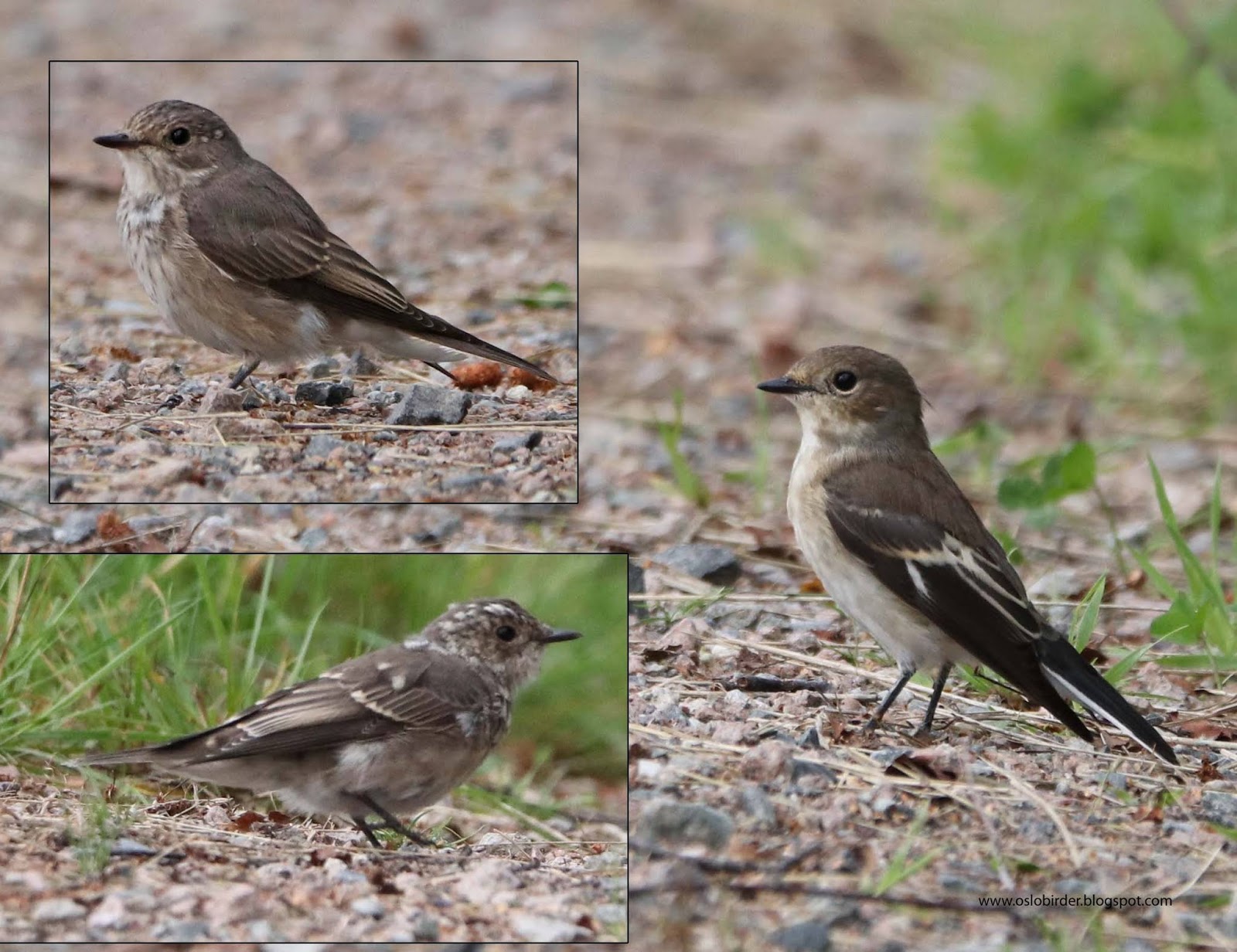
There are a lot of flycatchers in Maridalen at the moment. On the left are two Spotted Flycatchers (gråfluesnapper) and on the right a Pied Flycatcher (svarthvit fluesnapper). I belive all to the 1cy birds with the bottom left bird still in juvenile plumage whereas the other two have moulted to 1st winter.
Queen of Spain Fritillary (sølvkåpe)
Whooper Swans (sangsvane)
I child and dog walking trip to Fornebu this afternoon did not reveal many birds but there were a few dragons and butters to see
This is yet another new species of dragonfly for me: a Migrant Hawker / septemberlibelle / aeshna mixta. This species was first noted in Norway as recently as 2004 but has established itself including at Fornebu
there were quite a lot of small red dragonflies and I would normally assume they were all the same species but the all black legs show this one to be a Ruddy Darter / blodhøtlibelle / sympetrum sanguineum
and the pale backs to the legs plus black mark on side of eye show this to be a Vagrant Darter / sørhøstllibelle / sympetrum vulgatum although this species is very similar to the Common Darter / senhøstlibelle / s. stroilatum
and here a Common Ble Damselfly /innsjøvannymfe / enallagma cyathigerum
and a female Emerald Damselfly / nordmetallvannymfe / Lestes sponsa
and here a male
and finally a Common Blue (tiriltungeblåvinge) which is unusual in that it doesn't have any large spots (showing) near the base of the upperwing
Today didn’t feel like a special day but with 8 new
species for the year it clearly was good! Anders and I headed to Nordre Øyeren and visited
Svellet, Merkja, Tuentangen and Snekkervika. It never felt like there
was any avian activity with the high pressure still ruining things but there
were birds here and there and my year ticks were: Greenshank, Common Sandpiper,
Jack Snipe, Little Ringed Plover, Whinchat, Redstart, Willow Warbler and
Swallow. We also had 10 species of wader which is a sign of things to come. In
addition to the 4 mentioned above we had Golden Plover, Curlew, Oystercatcher,
Snipe, Lapwing and Green Sandpiper. Svellet is looking very promising but needs
some rain and a slight increase in water levels as it is very dry at the moment
and there were only 11 Curlew. The whole of Snekkervika was dry to beyond the
end of Årnetangen and with heat haze it was hopeless to see what was out there.
Raptors disappointed as we had hoped for some harriers and we only saw upto 6
different Kestrels, 4 Buzzards, 2 Sparrowhawk and an Osprey.
There were 400 Teal on Merkja but a pair of Pintail
was the only interest among them although we did find a male Garganey at
Tuentangen alongside just 10 Teal.
Luckily there were not too many photos to go through
today (it’s much quicker that way..)
male Garganey (knekkand)
male Whinchat (buskskvett)
male Redstart (rødstjert)
Queen of Spain Fritillary (sølvkåpe). This is my first early spring record of a species that is rapidly increasing in Norway and used to be more of a summer migrant
Well I didn’t do it. Instead
of visiting Årnestangen and Nordre Øyeren five days on the trot I decided to
visit Oslo’s islands. Mid September must be the best time to find something
interesting out there but it is rare that I visit them on what would be the
best days weather-wise as I normally prioritise a trip to Årnestangen when the
weather looks good (i.e. rain and wind). Today’s trip was far from optimal with
a trip out on Monday or Tuesday having been far more likely to produce an
interesting wader whilst by today the birds have now had three days without
rain in which to move on.
I was not disappointed
though and at least nice weather meant I could take some nice photos. Before
taking the boat I looked for the King Eider although failed to find him. There
are still lots of Common Eiders in the area so he is probably still around and
many of the male Commons are coming back into breeding plumage so we can just
hope that we will also be able to see the King in a plumage more fitting of his
name. A Razorbill though was a sure sign of autumn.
The boat trip out revealed
a 1st winter Arctic Tern which is a good Oslo bird and on
Gressholmen I chalked up an impressive three species of wader with two young
Dunlin showing ridiculously well and a Greenshank and Redshank feeding together.
A few Chiffchaffs with slightly strange and exciting calls had me hoping that a
Yellow-browed Warbler would turn up but if course it didn’t.
On Lindøya there were
still 15 or so Common Terns that were joining Cormorants and large gulls in
feeding in a frenzy offshore that was presumably caused by larger predatory
fish rounding up a smaller species. Most of the terns were youngsters and they
are all fending for themselves now. The juvenile Red-necked Grebe was still
present and showed at close range.
On Nakkholmen I had a
juvenile Bar-tailed Godwit which is, I think, only my second Oslo record, a
Redstart which is a species that always gets my pulse racing and an Osprey that
revealed its presence by calling.
Back home I had a garden
tick with a long overdue (especially given its name) Garden Warbler. It was
feeding on elder berries that normally attract Blackcaps later in the autumn.
This year the bush is heaving with berries so will be worth keeping an eye on.
It is only 6 days until I
am on Værøy and Tore Berg who is already there had 48 Yellow-browed Warblers
and 2 OBPs yesterday so it sounds like it will be good!
juvenile Red-necked Grebe (gråstrupedykker)
juvenile Bar-tailed Godwit (lappspove) with Oystercatcher (tjeld)
a slightly unsual location for both species
Two juvenile/1cy Common Terns (makrellterne)
one of them having a scratch
juvenile Dunlin (myrsnipe) moulting into winter plumage
Greenshank (gluttsnipe) and Redshank (rødstilk)
Osprey (fiskeørn). Andreas Gullberg photographed hte same bird (broken 4th finger on right wing) over his house 50 minutes earlier. Andreas has managed to age as an adult and sex as a male and I believe him but need to do a bit of reading up as I previously have never gone further than ID to species...
Red-breasted Merganser (siland)
Queen of Spain Fritillaries (sølvkåpe) are still going strong
My Sigma 150-500mm which has served me
well for 6 years or so was on its last legs (optical stabiliser broken and the
zoom locked on 150mm) so instead of a costly repair I decided to upgrade. The Canon 550D which is even older is still working fine but is so
outdated that it too deserved an upgrade.
I like to keep with what I know so the new lens is a Sigma
150-600mm and the camera a Canon 77D. Both of these are relatively cheap but
will offer a major improvement on my previous (not too bad) photographic endeavours.
From my first use I can see that autofocus is much faster, the
lens is sharp at lower f stops meaning I can use much faster shutter speed and
the exposure is significantly better. So, all in all it looks like I have
chosen well whilst keeping within the budget of a poor bird guide :-)
Birding the last two days
has seen a (relative) raptor bonanza. Yesterday at Årnestangen I had eight
raptors of eight species (so not exactly numerous) and then added an extra
species (Honey Buzzard) in Maridalen. Amazingly enough these species did not
include Common Buzzard which is the commonest raptor in these parts! I did add
Common Buzzard in Maridalen today though (where I had six raptors of five
species) so ten species in two days ain't bad going. The species were
White-tailed Eagle (a sub ad), Marsh Harrier, Hen Harrier (my first of the
autumn), Osprey, Honey Buzzard, Common Buzzard, Peregrine, Kestrel, Sparrowhawk
and Goshawk. Even though ten species is very good going there is still a chance
for more as Hobby, Merlin and Rough-legged Buzzard should all be possible now
and not to mention that Pallid Harrier..
Here are a few pictures taken
with the Bazooka II. The light was pretty poor and I still haven’t got the hang
of all settings etc but think it is going to be good.
male Southern Hawker (blågrønnlibelle)
Greylag Goose
Jay
mating Common Darters (senhøstlibelle)
a few Queen of Spain Fritillaries (sølvkåpe) are still going strong
this picture shows of a white bird in flight would not have been possible with the old bazooka
I was a bit rushed with this photo of one of Maridalen's two juvenile Black-throated Divers (storlom) which were having flying practice today. There has also been a juvenile Red-throated Diver together with an adult although these did not breed on the lake but close by on a small lake in the forest