Stage 2 of summer hols 2026 is as usual in Beitostølen. We have escaped the hot weather but maybe a bit too much with rain and cloud threatening to put an end to buttering before it begins.
On the first morning I awoke at 4am and decided to head for Valdresflye. Dotterel, Shore Larks and Long-tailed Ducks were a treat but it is not a lemming year and I did not see a single raptor or Lt Skua although there has been the odd sighting of some wandering skuas in the last few weeks.
Female Dotterel (boltit). A few females were flying around «singing» perhaps in the hope of finding a male that was looking to nest again after a failed first attempt
Valdresflye looking west on 1 July at 05:21. Not much snow this summer
Shore Larks (fjellerke) were the most numerous passerine. This bird was collecting food for young whilst others were singing
Heading further north to one of my favourite buttering sites I was treated to some fantastic views but my hope of enough sun to have some butterfly action were dashed but I did find a few Alpine Argus (fjellblåvinge) sleeping on flowers which was perhaps even nicer than watching them flying around. This is one of my favourite butterflies and does not get the attention I think it deserves.
Views looking east over Øvre Sjodalsvatnet at 06:10
A sleeping Alpine Argus (fjellblåvinge). It was early (06:30), chilly (10C) and cloudy so no wonder it wasn’t flying
Yellow Wagtails (gulerle) seemed to be having a good breeding season with lots of alarm calling adults and birds with beaks full of food
There was some blue sky but any sunshine only lasted a few minutes
The only other butterfly I found sleeping were a few Small Heaths (engringvinge)
Birding surprise of the day was hearing a Quail (vaktel) singing from these fields at 900m alltitude
There are always lots of Sand Martins (sandsvale) at the butterfly site. I have never worked out where they nest but think it may be amongst the rocks that form the foundations for some old farm buildings
The weather has continued to be conducive to raptor watching
in Maridalen and I hoped to be able to pin down, at least roughly, where the
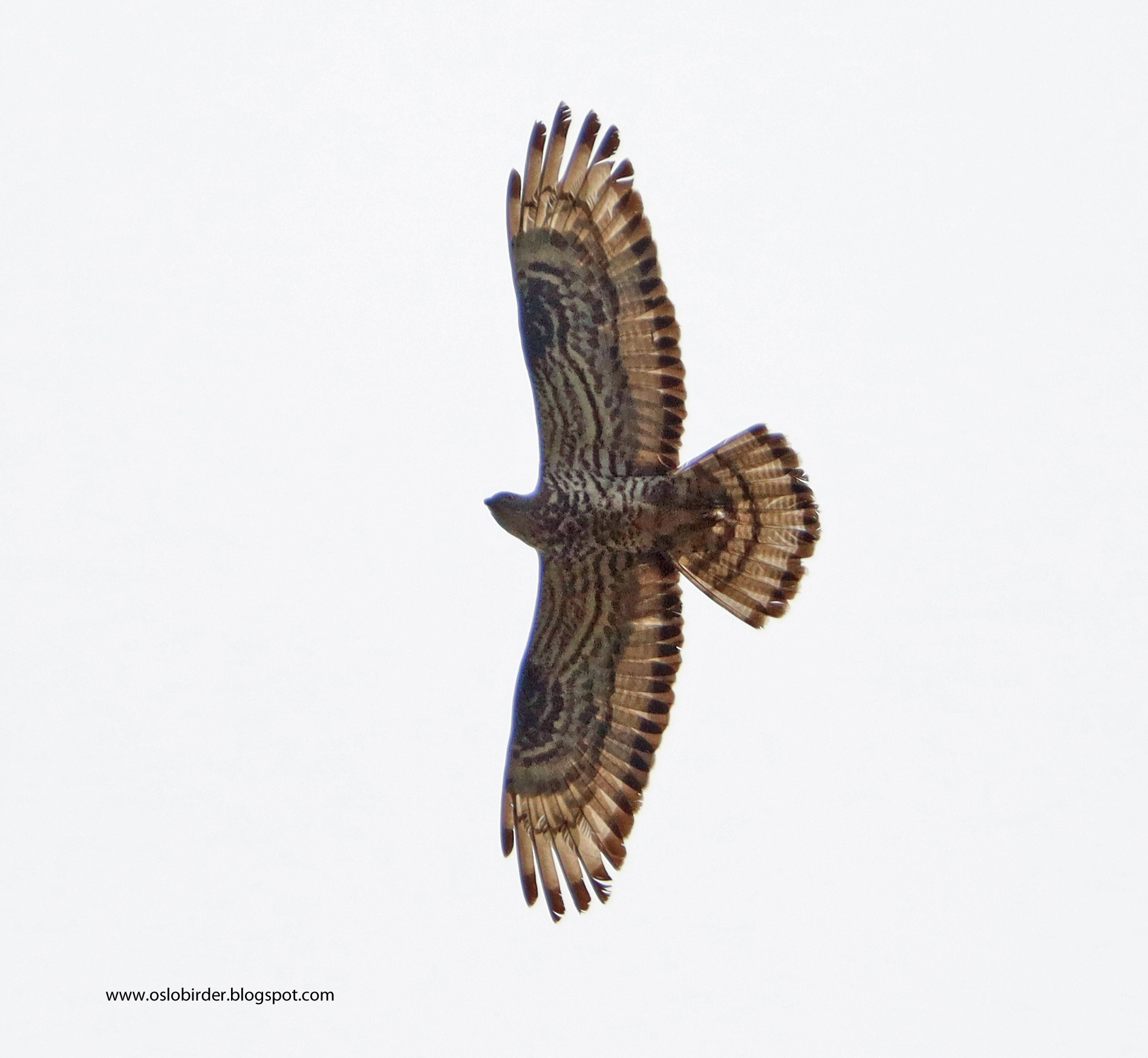
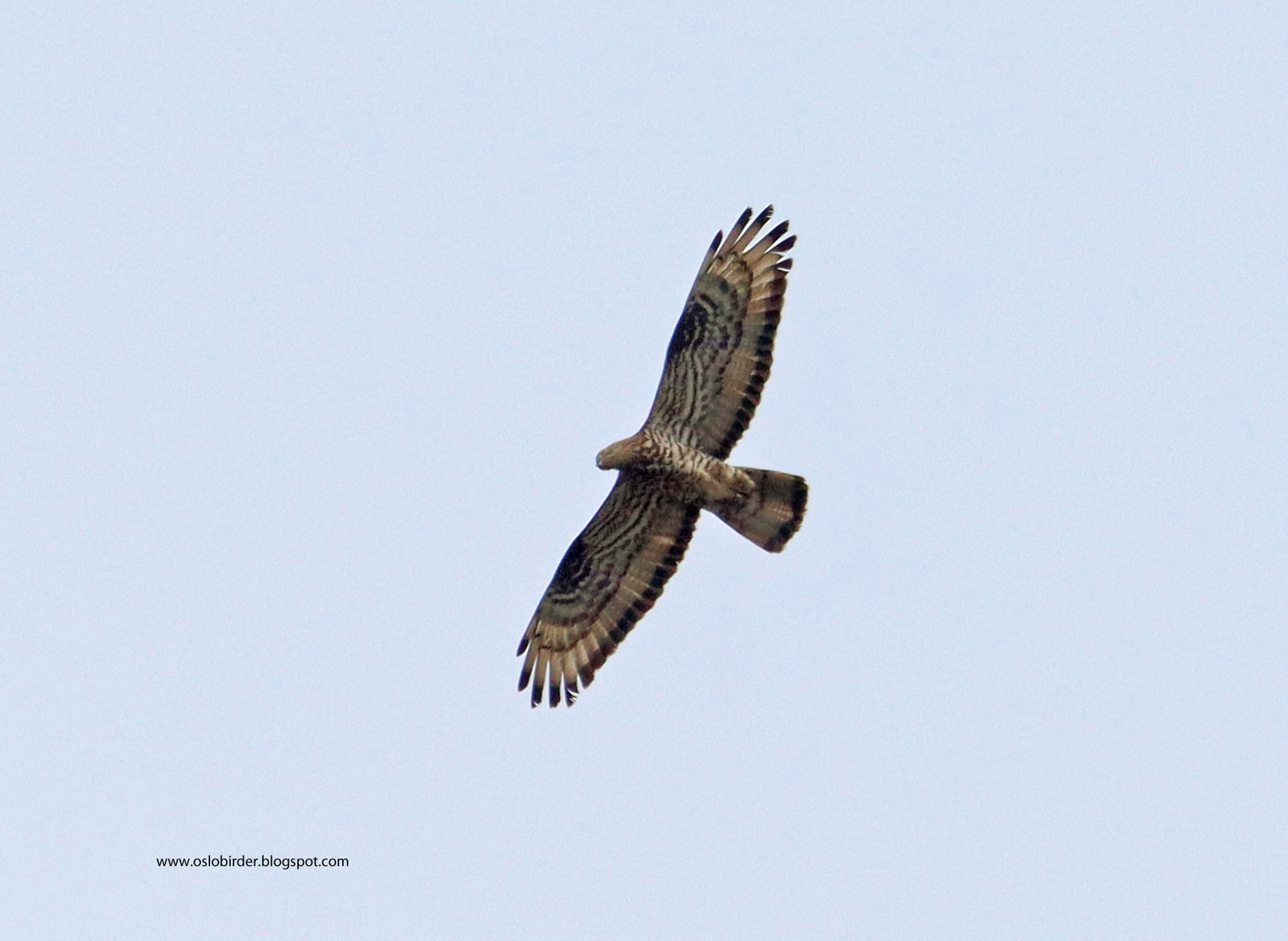
Honey Buzzard has a nest but despite seeing and hearing him I have come no
closer. However, I have found photos of the same bird showing quite how large a
range he covers in his search for food. He must even at times fly very close to
the nest I follow showing how different pairs share the same feeding territories.
Given how widely he travels though then I find it strange that I have not knowingly
seen “my” male anywhere but at/over the nest.
By looking at my pictures and other posted online I have
found out that the recent male is the same as the one I saw skydancing on 26May and which has been seen by Stig over Tonsenhagen (SE of Maridalen) on 17August and yesterday and was also seen on Friday south of Sognsvann which was the
same day I had two sightings in Maridalen. This bird can be individually
identified by its almost perfect plumage with no missing feathers but some very
specific damage to the primary tips of the left wing allow it to be recognised
with certainty.
the male in Maridalen on Friday. I have circled the specific feather damage that can also be seen on the photos I have linked to plus in my photo from the last few days on this blog
the lines at the top show how I saw the bird on Friday, the red cross is where is was seen the same day and the blue cross where Stig has also seen him. In the bottom left is the scale for 1km so he moves a long way
on Friday he returned calling and I heard him from over 1km
my first juvenile also on Friday. He appeared from the same area where the male had flown to but continued flying south on his own so was I believe a migrant
this Hobby (lefrkefalk) showed well
another Hobby trying to catch something
juvenile Sparrowhawk (spurvehauk)
an Osprey (fiskeørn) at Fornebu on Friday
and one of three in Maridalen the same day. This a juvenile I believe
and an adult yesterday which flew a long way north with this fish so clearly has young on the nest still
a migrating Kestrel (tårnfalk)
Yellow Wagtail (gulerle)
my first Whooper Swan (sangsvane) in Maridalen for a while
Water Rail (vannrikse) and Moorhen (sivhøne) at Fornebu
the Water Rail trying to hide
this Moorhen has been alone since it was very small but has raised itself well
Here are photos of the more photogenic but sadly less rare
raptors from yesterday with a couple of pics from today. The Honey Buzzard sighting
was very interesting. I wrote that he was not near his nest (not that I knew
where the nest was) when he was calling but that looks not to be true. Upon
looking at my photos I see that when he flew over me he was carry a disc of
wasp cake but when he returned only 7 minutes later (which is when he started
calling) he was empty taloned. This surely means that he delivered the food to young
(in a nest) only 3 minutes flight away and he was not flying fast either. Neither
was he flying towards dense forest and although he disappeared for me due to a
line of trees I think the nest must be in one of a couple of low lying woods.
Today the same male appeared from the same direction (although quite high up)
but dedicated watching revealed no other sightings or clues as to where the
nest is.
Two male Goshawks were also interacting yesterday – one looks
to be an adult male and the other a 3cy male which is perhaps trying to muscle
in on a territory.
An adult and juv Hobby were also interacting with each other
and a Sparrowhawk high over the lake and it is unknown whether these were from
the local family or from further away.
male Honey Buzzard (vepsevåk) with a disc of wasp comb in its talons
and 7 minutes later without
here he is straining his neck as he had an Osprey, a Common Buzzard and perhaps most important a Goshawk to be aware of
his beak is open and he was calling
performing contortions
the same bird today. In the field in challenging light I thought this was a female but it can be seen to be the same male
Common Buzzard (musvåk) - a moulting adult
Sparrowhawk (spurvehauk) - there are a number of juvenile birds around that have fun practicing their hunting skills of anything no matter size
another bird
a male Goshawk (hønsehauk) with a Wood Pigeon (ringdue). This bird has a mix of old and new feathers and is a 3cy
this is probably the same bird but taken today, whereas other picture was taken yesterday
2 male Goshawks together yesterday
the closer bird is the presumed 3cy whereas the bird on the left is an adult. Note how it has the white undertail covert feathers puffed out which normally happens during display
adult above
Osprey (fiskeørn) - adult male
juvenile Hobby (lerkefalk) left sparring with one of its parents
the same juvenile, aged by the absence of red trousers
and here the youngster is sparing with a young Sparrowhawk
adult Hobby with its red trousers
Nutcrackers (nøttekråke) are regularly to be seen flying high overhead with their crops full of nuts. They fly many, many kilometres from the city into the forest where they store the nuts for winter consumptions
the fields are rather disappointing but there a few Yellow Wagtails (gulerle)