A final post before the first migrants arrive and all hell
breaks lose (in my dreams).
If the weather forecast plays out then today marks the end
of this winter’s big freeze and from tomorrow positive temperatures, some rain
and southerly winds will hopefully kick start the first wave of spring
migration 2026.
Winter had a final gift in the form of a big dump of snow on
Sunday night and this extra snow will, I hope, ensure we get some good spring
flooding that hopefully will last many weeks. I really hope that Hengsenga on
Bygdøy will have flood water until at least the beginning of April as I believe
there is the potential for something very good here.
I have seen some signs of spring despite the weather not yet
having changed. A Wood Pigeon heading north on the early morning dog walk on
Tuesday will be the first of very many and a Greylag Goose looked a bit forlorn
on the ice at Østensjøvannet but today provided another two and better species.
In my last post I listed three early migrants that I hoped to find soon and all
had names beginning with S. After writing it I realised I could have added
another S species to the list, namely Stock Dove. When visiting Bygdøy today
hoping to find the first Oystercatcher of the year I stopped off to see if any
Stock Doves had returned to their usual spot and sure enough one was sat atop a
usual tree which is Oslo’s first in 2026. Huk didn’t have an Oystercatcher yet
but a flock of 8 Twite flying over were also Oslo’s first of the year but
rather than being migrants may be birds that have wintered on islands close by
taking a bit of a fly about. 17 Guillemot on a flat sea was a notably high
count for the time of the year but I couldn’t find any divers or grebes which
should soon appear.
I am really looking forward to the coming week and have high
hopes for both Bygdøy and Østensjøvannet but think Maridalen may have to wait a
bit longer as there is still so much snow.
a total of 4 Little Grebes (dvergdykker) at Kongshavn on Saturday. This is a joint highest count for Oslo and I would love to know where these birds breed
they acted as though they were two pairs and called a bit but are not yet in summer plumage
Østensjøvannets female Pintail (stjertand) now with bling
Pygmy Owl (spurveugle) in Maridalen on Sunday
Greylag Goose (grågås) at Østensjøvannet on Monday
my first Lesser Spotted Woodpecker (dvergspett) of the year. It was not drumming or "singing" but gave itself away through its weak tapping
Maridalen at its wintery finest
distant Pygmy Owl on Tuesday
and much closer
here, it had just visited the old woodpecker hole which I photographed it in in my last post and flew out with this mouse! I have assumed that this particular bird is living off its larder at the moment as when I see it in tree tops it is just looking as though it is enjoying the view rather than hunting
The first Greylags at Bygdøy Kongsgården but I bet that in a weeks time there will be triple figures here and hopefully with some smaller, scarcer cousins in their midst
Oslo's first Stock Dove (skogdue) of the year
Water Rail (vannrikse) still going strong at Østensjøvannet
and Jacky Boy is also still going strong. The upcoming thaw will be good news for them but will also, I fear, make them more difficult to find
It has been commented that I moan about the weather nearly
as much as I write about birds and that is no doubt correct and to prove it –
the weather is just wrong at the moment! +12C night and day, southerly winds,
overcast and drizzle and not a good, out of season bird to show for it…I’m
hoping for Pallid Swift, Hoopoe, Desert Wheatear or at the absolute minimum a Firecrest…
I’m not sure if out of desperation or a real expectation
that there would be something good but I found myself sea gazing at Krokstrand
yesterday. The site of many a good seawatch a decade or more ago it now serves as
a reminder of how autumn weather patterns and arrivals of seabirds have
changed. For the nostalgia value it was good to be there and remember previous visits
with skuas of all 4 species, Brunnich’s Guillemot, Sabines Gull, Grey Phalarope
and all the more expected but still for these parts unusual stuff. Yesterday
wasn’t a disaster and there were birds and not just sea to gaze at but it was
not a day that will be remembered in a week’s time let alone a decade’s time.
Three Kittiwakes were the best of the bunch and there were double digit numbers
of Guillemots along with three each of Razorbill and Little Auk but I could
just as easily have seen the auks in Oslo.
A nocturnal visit into Maridalen with the thermal imager
revealed unsurprisingly that Woodcock are still around with 4 seen along a short
stretch. Slightly more unusual was a single Common Snipe and two Fieldfares that
were seemingly roosting on the ground in a stubble field. Nearby at least 20
Magpies were roosting together in some isolated bushes. A Tawny Owl called but
I picked up no other owls hunting over the stubble fields despite there seeming
to be increasing numbers of mice.
Krokstrand looking south towards more open sea
and looking north towards Oslo and the end of the fjord
Woodcock (rugde) taken just with the aid of my head torch
and here using the camera's inbuilt flash. Note how far up the mud goes on the birds long beak showing quite how deep it has been probing for worms
a Fieldfare (gråtrost) one of two which I believe were roosting on the ground rather than nocturnal feeding
and a Common Snipe (enkeltbekkasin)
an unusually easy to observe Little Grebe (dvergdykker) on the park lake at Valle Hovin. In Norway it is unusual to see one so well
Whilst I was away at the weekend the ice melted on
Maridalsvannet. This is early but despite it having been so dry the water
levels are currently high so the lake doesn’t yet look that appealing. That
being said though there have already been some good birds and maybe when the
ice doesn’t melt until the end of the month as is often the case that means
that a lot of birds are missed out on as they cannot splash down even if they
wanted. Both species of diver are already back and their display calls ring
around the valley. More impressively though has been the three , yes 3, species
of grebes that have graced the lake. Following last years first ever record of
Little Grebe in the Dale a bird in exactly the same place it was probably the same
bird. Great Crested Grebe is more expected but a Slavonian Grebe hanging out
with Teal is record early as this species normally passes through, and not
annually, at the end of the month.
Raptors are still very thin on the ground but the first Osprey
of the year turned up on Tuesday and a Peregrine was hunting in the valley
today. Today also finally saw the first day with really good numbers of
passerines on the (very dry) fields: Bramblings, Redwings and Meadow Pipits
were the most numerous.
A real treat today was being able to listen to the calls of
migrating Curlews and a flock of 6 really wanted to land but in the end gave up
and flew north.
an ice free Maridalsvannet looking towards the south
my first Osprey (fiskeørn) of the year - a particularly well marked female
migrating Curlews (storspove)
Little Grebe (dvergdykker)
Slavonian Grebe (horndykker)
and the best picture of all, a Great Crested Grebe (toppdykker)...
there have been up to 10 Lapwing (vipe) on their favoured two fields and there are already two nests. Nest 1
Nest 2
Green Sandpiper (skogsnipe)
a Kestrel (tårnfalk) today and a Brambling (bjørkefink)
a young Peregrine (vandrefalk) that I saw three times today
Yesterday I thought I would see if Sørkedalen had anything more to offer and caught up with the plastic hybrid goose that has been around for a couple of weeks and a real piece of plastic had me for quite a few seconds thinking I had seen my first Ring Ouzel of the year…
what looks to be a hybrid Emporer x Barnacle Goose together with Pink-feet
Friday’s glorious sunny weather continued into Saturday but
today saw a return to the fog and in addition to it being harder to see birds
there also seems to be far less avian activity.
Yesterday I was driven around by Jr and we ended up at
Fornebu where I got to see Elvis, aka The King, aka the King Eider MUCH better
than on Wednesday although it was still at a range of 1.2km so cannot really be
seen in binoculars, or a camera view finder for that matter.
It was also possible to grill the 300 or so Velvet Scoters but
I couldn’t find any with knobs although if this flock continues and attracts
more birds as spring approaches then the chance of White-winged Scoter of either
species must be more than miniscule. A Scaup was the best of the rest.
the King Eider (praktærfugl) is definitely identifiable in my pictures now and the black sails help you to find it even when the whole bird is not on show
two Little Grebes (dvergdykker) were also added to the year list
It looks like an invasion of Two-barred Crosbills is
brewing. After my sighting on Monday of a bird with Common Crossbills in a
spruce forest I was rather surprised to find a lone bird today in birch trees
by Nordre Øyeren wetland. It was calling a lot and I managed to record it both
the trumpet call and more generic crossbill call. This bird was also a juvenile
but hopefully some adult males will arrive soon.
I left Oslo to go to Øyeren as I hoped for some raptors
specifically harriers but a single Marsh was the only one. Common Buzzards were
numerous though and the local White-tailed Eagle family showed well. A single
Great White Egret was a now to be expected bird but less than 10 years ago
would have been quite the mega.
a streaky juvenile Two-barred Crossbill (båndkorsnebb)
I got fairly close but unfortunately it was high above me
this Little Grebe (dvergdykker) is my first ever at Nordre Øyeren and seems to be a surprisingly rare species there
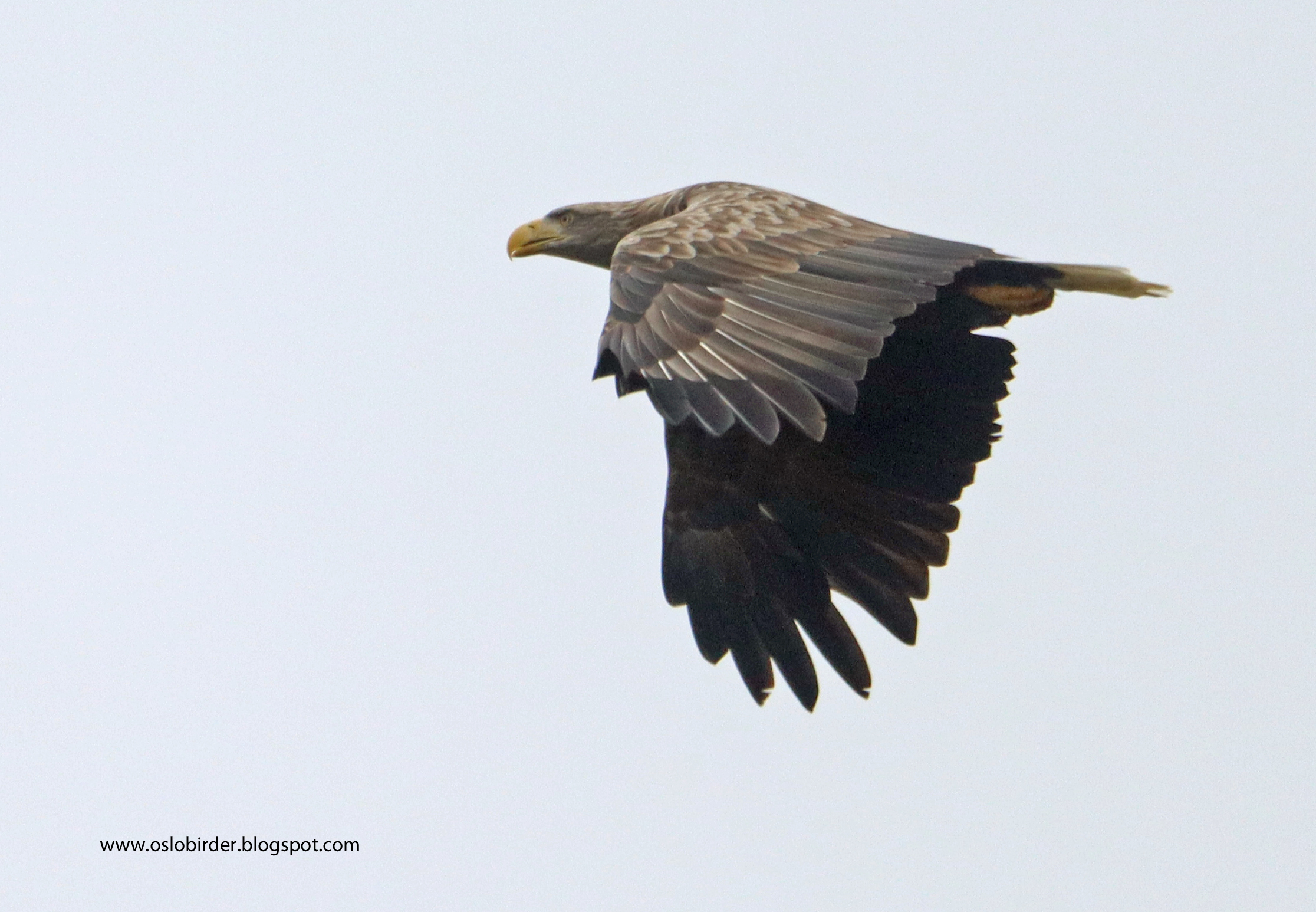
Great White Egret (egretthegre) AND White-tailed Eagle (havørn)
with such a large bill this must be the adult female eagle