Showing posts with label Ortolan. Show all posts

Friday, 20 June 2025

Mid June

 This week I have twice guided to Hedmark and it has been unusually easy! Ortolan was a target on both trips and both times the bird was spotted singing from roadside wires and all that was needed to do was wind down the window to enjoy its lovely song. After over 5 weeks on territory he still seems to be unpaired although on the first visit I thought I could hear two birds calling although on the second visit there was nothing to suggest more than one.

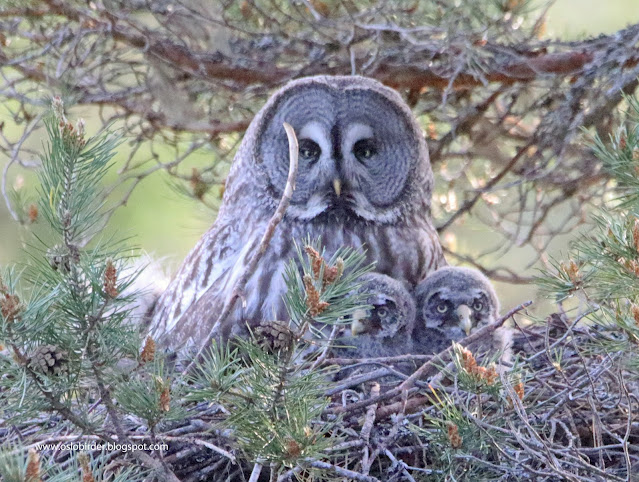
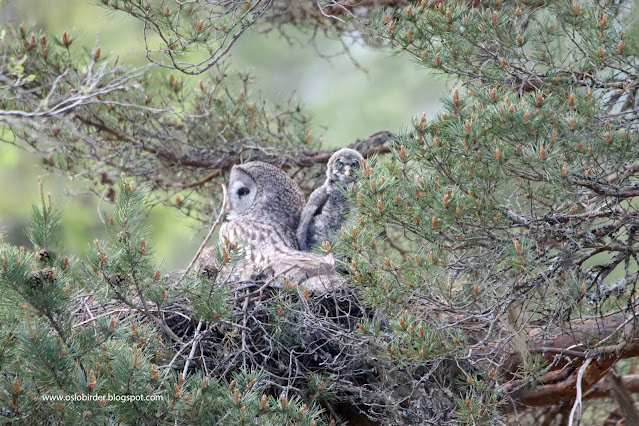
Great Grey Owl was only a target of the second trip and that only required stepping out of the car to hear the young begging for food. I knew the young had left the nest 10 days ago and was prepared to have to search for them but no, they were waiting for me 😊

We found only 2 large young and it therefore looks like one has been lost but we had both parents although in an hour and a half saw only one delivery of food so it may be that the vole population has crashed.


Falling water levels have allowed me to get an overview of the Lapwing breeding situation in Maridalen. The remaining birds have moved from the breeding field to a nearby muddy bay and here I was able to find 8 young from 4 broods. 1 was fully grown, 1 quite large, 3 small and another 3 very small. I expect more will be lost but this was a better situation than I expected although from 5-6 pairs it is hardly great. 


The Oslo Honey Buzzards are on the nest 10 days earlier than last year although we are still to see them in the air despite quite a lot of watching - they are sneaky birds!


I have only videos to add to this post as I seem to have lost the still photos I took. There is also a video of 2 Little Terns that are only my second sighting in Norway and which I twitched at the (again?) Mighty Svellet.


Saturday, 31 May 2025

Thursday videos

Here are the videos from Thursday.


We arrived at the Great Grey Owl nest at 20:00 and it took a while before we saw the young and they gradually became more visible, active and noisy but it wasn’t until 21:14 that dad arrived with food. This is in contrast to six days previously when we witnessed three food deliveries in under an hour from 18:58 onwards. The young are coming along well so I don’t think there is a question of lack of food but maybe different weather plays a role. Thursday was a sunny day whereas six days previously had been overcast and therefore darker earlier on (I also noted that Woodcocks were first active later much earlier last week).

The mother really does seem to be good at her job and still shelters the young between her wings and she probably has not left the nest in close to two months. When the food delivery finally came we could not see what had happened but the female was definitely not feeding the young by tearing off strips of meat so I thought that maybe she had swallowed the vole herself which then had me questioning her motherly instincts. The video however shows that one of the young (the middle one?) took the vole from her and swallowed it whole! Things have definitely moved on from six days previous when she was feeding them tiny morsals of flesh individually.

I have two videos from the nest. The first is just the food delivery sequence where I also captured the male flying in on my phone and the second and much longer video has various snippet of action from the whole period we watched them.


Here is footage of the hunting GG we spotted along the road. Initially perched on a wire by a house he then made an unsuccessful plunge for a rodent before moving to fence posts. You can also see how he changes his posture in response to a Hooded Crow flying over.


Here are a pair of Red-necked Phalaropes


And finally, Norway’s only registered singing Ortolan Bunting in 2025. The nest I found in 2023 may end up being the last breeding of this species in the country as last year just two unpaired males were recorded and I did not see anything on Thursday to suggest that this male who has now been back over 2 weeks had a mate.


Friday, 30 May 2025

Holiday driving

Yesterday was a bank holiday in Norway and Jr and I used it to take a looooong drive. She takes her driving test on Monday and is keen to get in driving practice and I have places I want to bird but no longer find the long drives much fun. It is therefore a win win if I get chaffeured and Jr gets the practice she wants. We were out 13 hours and clocked up just shy of 600km. The destination was a first trip to the mountains for the year. Not Beitostølen / Valdres but Ringebu which I have developed a taste for.


First stop was to check out a Tengmalm’s nest that Per Christian and I had discovered in April. No bird showed and I am really beginning to think it is my trunk scratching technique that is the problem rather than there never being owls in the holes. A very small and rare butterfly was a good compensation though with a few violet copper (fiolett gullvinge) on the road verge. I have previously found a very healthy population a couple of kilometres away and this very normal looking area of open pine forest clearly holds good numbers of what otherwise seems to be a declining species.


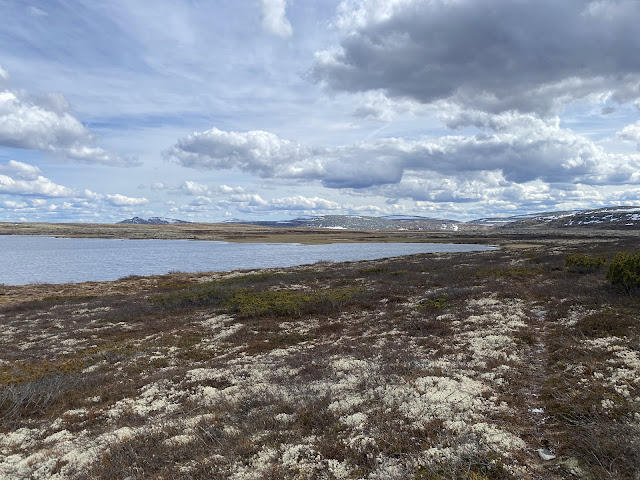
After this we headed higher and above the tree line. There was no snow but it was all very brown and the birches on the tree line were yet to come into leaf. The lake and marshes I was headed for were ice free and there were quite a few birds but clearly a number of migrants are not back yet. Although there were fair numbers of Yellow Wagtails and Meadow Pipits I found no Bluethroats, Lapland Buntings or Wheatears which should be numerous. There were also no raptors, owls or grouse so it is clearly not a rodent year in these mountains.


Waders were back though. My target was Red-necked Phalarope and two pairs were probably only just in. Redshank, Wood Sandpipers, Golden Plover were also all on territory and there were 3 or 4 calidris waders in song flights at some distance that gave me a bit of a headache. When I initially heard the «song» I identifed them as Broad-billed Sandpipers but then I started hearing Dunlin and a Dunlin landed close to me. I assumed they were all the same species as they were flying around together and then started thinking I had misheard and they were all Dunlins.


Lucky though I did take some terrible distant photos and there were clearly both species flying together. I now wish I had walked further into the marshes (my feet were already wet anyway) and tried to see them properly.

After this we needed to get some food and headed for Elverum where after a McD we then visited Norway’s only known singing Ortolan and then the GGOs. This time we had to wait over an hour for a feed but it was fun watching mum and the young getting increasingly hungry and impatient. Then driving home we had a roadside GG hunting in someones garden 😊


Today, a post on Facebook reminded me that it was about time I twitched a butterfly. Scarce Heath (heroringvinge) is rare in Norway but occurs on a couple of islands (one of which is connected to the mainland) only 6km from Fornebu. They were easy to find and the habitat - some open ground backing onto gardens - looked very ordinary. This species seems to be extremely sedentary and although it can be well established in one small site seems unable to expand onto other sites just a few hundred metres away.


I’ll post pictures now and will come back with videos which should be good although knowing me I will have failed to press the record button when I thought I had.


a male Red-necked Phalarope (svømmesnipe)

and a female. This is one of the very few species where the female is the more colourful of the sexes

habitat

Dunlin (myrsnipe) and Broad-billed Sandpiper (fjellmyrløper). I regret now not trying to get closer to the area they were displaying over


size difference is just about possible to make out


Norway's only known singing Ortolan Bunting and the same bird I found on 10 May. Nothing suggested he had found a mate


Great Grey Owl (lappugle) watching. I should have some good video


the three young are growing and the two oldest are now grey instead of white. The third and smallest is just visible to the left of the other two behind the branch

one young was hiding under mums wing

and then climbed on top of her

male Violet Copper (fiolett gullvinge)


and the subject of today's twitch a Scarce Heath (heroringvinge)


Monday, 12 May 2025

Great Grey Guiding

So, this weekend was my first guiding to the Great Grey Owls that I found at easter. In Feb 2020 I had guided Darrel and a couple of mates for the taiga trio. We had failed to see Great Grey Owl that time and since then Darrel has asked me at least once a year whether there are any GGs to be seen 😊. He has had to be patient but finally this year I could inform him that GGs were a go go.

Darrel, Mike and Richard flew over with Ryan Air on Saturday and I picked them up from the airport around 1pm. We headed north straight away and the day was a bit of a roller coaster but ended on a definite high. Both Ural Owl and Tengmalm’s Owl failed to show at nests where I was confident we would see them but a singing Ortolan Bunting was a real bonus and will perhaps be the last territorial bird in Norway with the species not having been expected to return to its historical breeding sites this year.

I had of course saved the target bird for last and we were really in for a treat as we spent over 2 hours with the GGs. The female was on the nest and although we never saw any young I think from the way she was sitting that there may well have been a newly hatched youngster or two under her but she was also clearly incubating eggs. For a long time the female did nothing but look around often with her tail cocked but she did give her “I’m hungry” call a few times not that we could see the male. Then after a while she gave her excited chittering call and the male glided silently in with a vole that she took from him immediately. Our focus then turned to the male who perched openly and glared at us for a while before having a nap.

We then left them to see if we could find any hunting owls and succeeded with a roadside Great Grey right by a couple of Moose 😊

It was a long day and we were back in Oslo at midnight and I was glad to be able to get out of the car after a lot of driving.

The next morning was time for Maridalen’s finest and we caught up with Hazel Grouse, Three-toed Woodpecker, Wryneck and Black Woodpecker although not all were particularly photogenic.

Other interesting species we had over the two days were Crested Tit, Woodcock, Crane, Tree Pipit, Pied Flycatcher and Wood Warbler.


As usual when guiding I do not put much focus into my own pictures which was quite easy as the auto focus is broken on the bazooka but I did of course take some photos as well as quite a bit of video which is much better


the female Great Grey Owl (lappugle) on the nest
the male after delivering food to his mate


singing male Ortolan Bunting (hortulan)


a female Three-toed Woodpecker (tretåspett) in Maridalen


this hole had held a family of Tengmalm's Owl (perleugle) a week or so ago but there was no sign of life when we were there. The Camberwell Beauty (sørgekåpe) butterfly was scant replacement


Sunday, 20 August 2023

Norway’s rarest breeders

I have previously had two blog posts about my 24 hour trip in mid June which resulted in a number of very exciting birds and butterflies and I also wrote that “I literally stumbled on nesting pairs of what must be Norway’s two rarest species of breeding birds”.

Those of you who have followed this blog for a while may well have guessed that the two species were Ortolan and Rustic Bunting. Both species have been on a steep and long decline in Norway with trapping for food in passage and wintering areas being blamed. The official survey of Ortolan resulted in only 3 singing males at 3 different sites this year so obviously things do not look good for the future survival of the species. Things have got so bad for Rustic Bunting that there is no longer any official survey and the last breeding that I am aware of in the southern breeding grounds is from 2016. However (and something I forgot when I made my bold claim), in the last few years Rustic has started breeding in the far north of Norway in Pasvik on the border with Finland and Russia so my claim only relates to the historic southern breeding range.

I found the Rustic whilst searching for butterflies in a forest bog. I was in the middle of the bog getting wet feet when I heard what I was sure was the song of a Rustic from the woodland at the edge of the bog. I forgot about butterflies and made my way to the woodland. The song was coming from something like 30 metres into the woodland and as I made my way towards it I was suddenly aware of intense ”ticking” which is a noise I have heard before and knew straight away was from an angry Rustic Bunting. Quite soon I saw the source of the noise and a female Rustic was in a tree by me and then suddenly a male appeared. The intensity of their annoyance at my presence meant either a nest or young nearby. As I did not hear any other birds (young) calling then I think it was the nest (when I previously came across a young only just outof the nest it made a lot of noise) and I therefore made sure to check where I was walking as I tried to put a bit more distance between me and the birds. They calmed down but did not reveal where the nest was so I returned to the marsh.

It was a bit strange that the male was singing when he should have had his focus purely on feeding young. Either he was thinking of a second brood and trying to get the female in the mood or it was a different, and unmated, male that was singing. I heard a bird singing again later and I would actually think it more likely that it was an additional male but cannot say either way. What I can say was that it was an unexpected and fantastic experience and one that I had never thought I would again witness in Norway. Finding these beautiful birds on their taiga breeding grounds is really special 😊. This video has the sound of the singing male and ticking pair.


The female Rustic Bunting (vierspurv)


and the male when he suddenly announced his presence right over my shoulder


I looked for Ortolans where I have always done so. After a bit of waiting I thought I had heard a distant singing bird but was not convinced. I cupped my ears hoping to hear better when a much closer bird flew past me and made a call that I was quite sure was Ortolan. It landed in nearby trees and as I went closer it started alarm calling. I walked back trying to give enough distance that I would not be viewed as a threat but also allowing me to see what was going on. Another bird suddenly appeared and also called and I could see that both had caterpillars in their bills – clearly there were young that needed feeding! After a little wait the female dropped down before perching in a birch sapling and then dropping to the ground right by a regularly used farm track. I was able to reposition myself and saw the approximate area she flew up from. Walking along the track it was quite easy to find the nest which was only half a metre from the track! There were 4 young in the nest and all looked healthy but you have to wonder why they chose to nest there when there are piles of branches nearby which I believe are left specifically to offer protection for nesting Ortolans. I decided to contact the relevant people to inform them of the good news of breeding and also to share my worry for the nest given how close it was to where people, tractors and animals regularly passed. The information was received with enthusiasm and I felt good for my discovery. About a week later though it was reported on social media that an Ortolan nest had been “destroyed” and the blame was laid at the feet of “photographers”. Contacting the poster it was clear that he was referring to the nest I had found and I felt very much that I was somehow being blamed. It was also clear though that the use of the word “destroyed” was something that the poster had himself chosen to use in an attempt provoke as he himself had not seen the nest and had only received some information from the person I had informed about the nest. Contacting him I heard a very different story – he had checked the nest first 5 days after I had found it and he then found an empty nest with absolutely no sign of either predation or destruction. As Ortolan young are only in the nest for ca.12 days and the female broods them for 3-5 days then the young I saw could very easily have been (and indeed their appearance I think confirms it) more than 7 days old when I found them meaning that 5 days later they would have left the nest and of course the nest would be empty. My attempts to explain this to people who should know better fell unfortunately on deaf ears but let us hope I am right and at least one brood of Norwegian bred Ortolans made it in 2023.

the male Ortolan (hortulan) with food in its bill

and the female just before dropping down to the nest


nest site

four young


Monday, 23 May 2022

Videos as promised

 And here are the videos I promised

First 3 videos of the Ural Owls. A Director's Cut, a 1 minute of the adult female including her calling and then a 1 minute of the young in the box.


The song and calls of the Ortolans taken with my mobile phone

And the Caspian Tern and waders including Turnstone at Svellet (long range)


Sunday, 22 May 2022

Hedmark 2022

If you are reading this expecting an account of my time in the mountains and pictures of Bluethroats, Great Snipe, Dotterel and the like then you may end up being disappointed. If however you were just hoping to read about amazing Norwegian birds then I think you will be satisfied.

My trip with Conor to the cabin in the mountains had to be called off due to illness and I was left with the family not expecting me to be around and lots of birds waiting for me to see them. Instead of heading off to the mountains I decided to hit Hedmark on Friday. I used to do this trip at least once every year but have not done so since 2018 with Corona having put a stop to it for the last 2 years. My target with the trip was owls and Ortolan Bunting. Normally I would also try to see Rustic Bunting but this seems to have disappeared as a breeding bird in the south of Norway (although interestingly seems to be establishing itself in the very far north). Ortolan is also in danger of disappearing with just 6 pairs found last year at 4 sites. I visited the main site where as recently as 2016 I heard 6 singing males and only found a single pair. It is possible that it is still early in the season and more birds will arrive but this is not good news for the species. The pair did seem to in breeding mode though so if they raise a couple of broods then there is some hope. They were surrounded by Yellowhammers and it is difficult to understand what differentiates these species and stops them competing with each other.

After enjoying the buntings in their sandy farmland habitat it was time to entire the endless commercial forests where clearings and the provisions of nest boxes and platforms has proved to be good for two of our largests owls: Great Grey and Ural. Great Grey is the commonest but I failed to find any birds although if I had stayed until dusk then I would surely have done so. Ural Owl with under 20 pairs known in Norway is nearly as rare as Ortolan and is also similarly predictable in where to find it as they regularly use the same nest boxes. I visited a nest box I have seen them in before and where I know a bird was singing earlier in the spring only to find lots of recent foresty work and the tree holding the nest box felled. A frantic phone call to a man in the know revealed that the nest box had been moved and when I started searching where I believed it to be I was found by mummy Ural who flew towards me calling! She luckily kept her distance and I then saw the nest box which ultimately revealed itself to be holding three large young who will no doubt soon be leaving the nest at what seems like an early date. I kept a safe distance and mum calmed down and the young started peering out of the hole. At one stage dad sang from nearby and was answered by mum. I saw him briefly and hoped I would see food delivered but this did not happen and after a little while longer I took this as my cue to leave them.

The area also held Capercaillie, Black Grouse, Cuckoo, Redstart and Parrot Crossbill aswell as my first mosquitos of the year so was all in all a good stop.


I was pretty knackered by all the driving on Friday and had an uncharacteristic lie in on Saturday despite it raining and me knowing this was perhaps the greatest chance of finding something good this spring. On checking my phone I saw loads of messages of good birds and decided to head for a place where no messages had come from but which must hold something, namely the (once) mighty Svellet. I was glad to see there were waders and set about trying to work out what they were although the distance, light and rain made it difficult. I was hoping for Broad-billed Sandpiper but had to settle for a couple of Turnstones and Temminck’s Stints amongst Ringed Plovers, Dunlin, Redshank and Ruff. It is very interesting how there were no Greenshank or Wood Sandpipers which in the first half of May are the dominant species here and number in the hundreds. After 5 minutes I was joined by Reidar Myhre and whilst I kept looking through the small waders and ignoring the large white birds (gulls) in the area, he calmly asked me what I made of the tern sleeping amongst them (he knew what it was). Looking one meter behind the waders it was clear there was a Caspian Gull there and I felt a real sense of déjà vu to my visit on 16 May 2017.

After this very good result I thought there was a chance of something in the Dale. There were no large numbers of waders but 2 Ringed Plovers were only my second record there and caused Halvard to appear in a flash for a Maridalen tick. A singing Cuckoo was lovely to hear as I fear that every year will be the last time I hear one there.

As usual I took far too many pictures and video and have only managed to go through the pictures so far. The videos will come soon and there should be good ones there I think 😊

male Ortolan (hortulan)

female Ural Owl (slagugle)

distant Caspian Tern (rovterne) at Svellet

female Ortolan - a quite male like bird

same female

and the male again


the Ortolan pair

Yellowhammers (gulspurv) were side by side with the Ortolans

Ural Owl


three young in the nest box


not much room left

waders at Svellet including Turnstone (steinvender), Dunlin (myrsnipe), Ringed Plover (sandlo) and Temminck's Stints