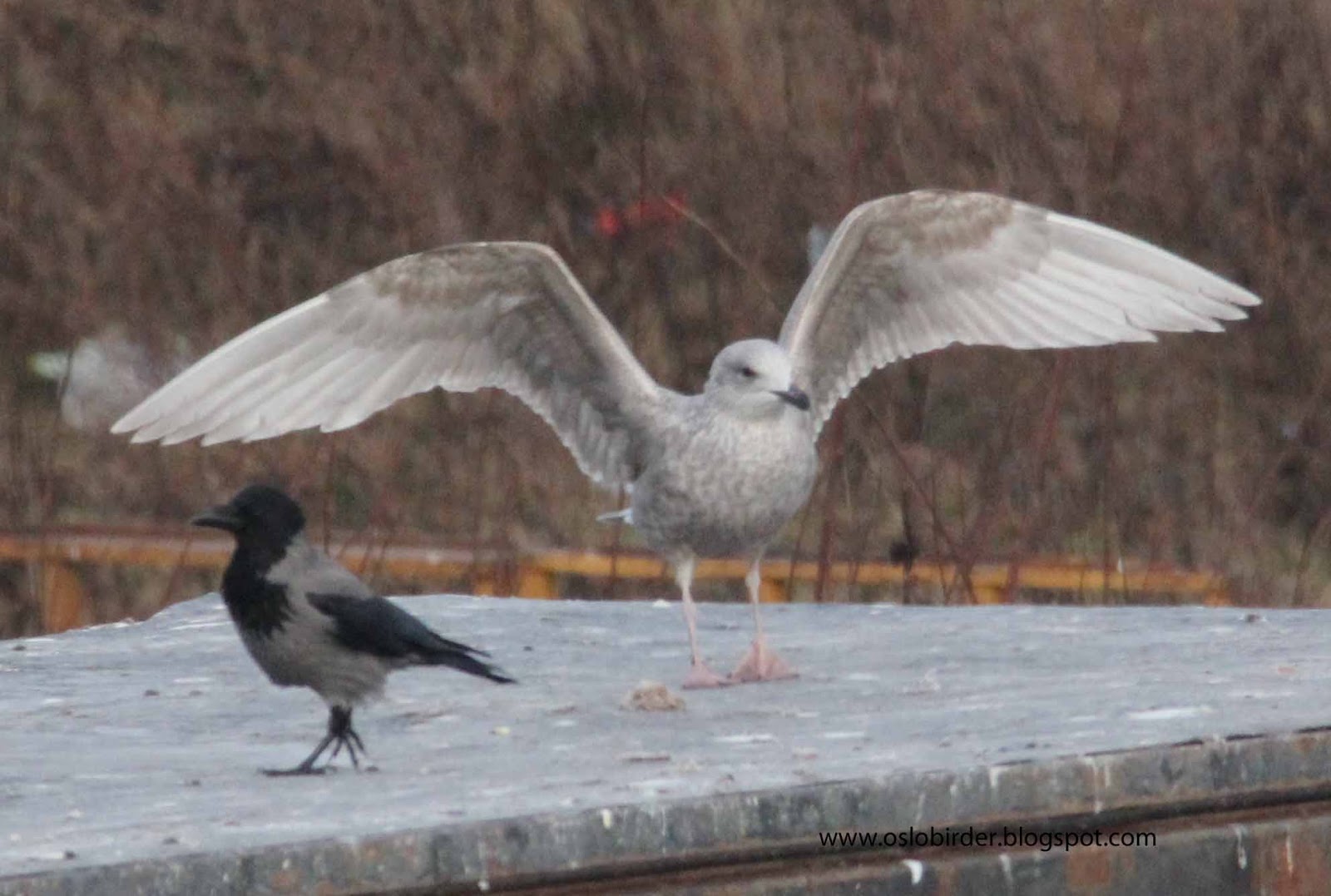
Showing posts with label Glaucous Herring Gull hybrid. Show all posts

Tuesday, 9 December 2025

Gulling - a sure sign of desperation!

It continues to be grey and virtually birdless – surely the least exciting bird winter in Oslo in the nearly 25 years I have lived here.

An appointment down town this morning allowed me to check out what urban birds there might be around the Opera. I failed to find the Peregrines on their normal perch on the Posten building so any excitement was going to be on the gull front which as regular readers know is not a family of birds that I normally find that exciting but rather frustrating. In addition me looking at gulls is a sign of complete desperation!

There was a large gang of mostly 1st winter Herring Gulls hanging around waiting to be fed. This autumn there has been a lot of social media focus on weak Guillemots on the fjord which has resulted in a campaign to feed them with fish and especially by the Opera where many Guillemots wait offshore to be fed. This source of easy food has of course been discovered by the smart and opportunistic local Herring Gulls and this has now resulted in them being fed on an industrial scale away from the Guillemots so as to allow the Guillemots to feed successfully and in peace. Personally, I am no fan of this artificial feeding as the young gulls are missing out on how to discover their own food (it was quite striking how relatively few adults birds were there) and there is plenty of natural food (starfish) at the moment.

I could find no white wingers or Caspian or even Caspian look-a-likes amongst the lazy gulls but there were two 1cy Herring with very creamy colours of the type that suggests a hybrid with Glaucous Gull. One of these was ringed and proved to have hatched in a nearby colony and with no reports of Glaucous Gulls this, or any previous, summer this (and a number of previously similar and locally bred birds) shows that these are pale colour forms and within the variation of Herring Gulls rather than hybrids.


A Lesser Black-backed Gull was perhaps the highlight. Wintering birds in Norway are rare and less than annual in Oslo and are normally young birds. This one had a black back and had previously been suggested to be a fuscus (Baltic Gull) which is also a very rare subspecies in the south of the country. Although the bird had a surprisingly little amount of streaking on the head I could see nothing else to suggest fuscus with there being an obvious contrast between black outer primaries and otherwise dark grey wings. There were a few browner feathers in the wings especially the median primary coverts which I initially took to be a sign of immaturity but the outermost primary (P10) was also brown but was clearly an adult feather due to its large mirror so these browner feathers must be older unmoulted feathers.  The tail was also completely white and the bill had no dark smudges that it has before full adulthood.

a very pale 1cy Herring Gull (gråmåke) that some may suggest is a hybrid with Glaucous Gull (polarmåke). Compare it to normally plumaged bird to its left. This bird was ringed as a nestling in a nearby colony and similar ringed birds in previous years seem to prove that these birds are just within the variation of Herring Gulls


and another similar but unringed bird

and an example of a very dark Herring Gull

the adult Lesser Black-backed Gull (sildemåke) in front of the Munch Museum

note that P10 is old an unmoulted, P9 has just been dropped and a new feather is growing out. The brown medium primary coverts and some secondaries are also unmoulted feathers contrasting with new, moulted, feathers

the wings are much too grey to be fuscus


note that the moult is symmetric in the left and right wings with the new P9 equally long


and a brute of a young Great Black-backed Gull (svartbak)

Tuesday, 17 October 2017

Marsh Tit !!

I wouldn’t normally employ the use of exclamation marks on conjunction with Marsh Tit but today warrants them – after 16 years of searching I saw one in Oslo! The species is a scarce resident in many parts of southern Norway and occurs in Akershus county within 10km of the centre of Oslo but for some reason appears to have no regular population in Oslo. There are 1 or 2 reports every year but I have not seen any that are documented and with the notorious difficulty of separating this species from the far commoner (in Norway at least) Willow Tit a number of the records will no doubt be misidentifications.

The bird I had today was at Østensjøvannet which accounts for more than half of the reports and historic records suggest that maybe the species has been resident in odd years but fails to establish itself permanently. Usually I identify Willow and Marsh tits by call without resorting to the small differences in plumage but today’s bird took a (surprisingly) long time to call and I had actually got around to identifying it on plumage in the meantime. The pale cutting edge to the upper mandible was visible on the back of the camera and the general warmer tones, lack of a wing panel and small black bib were enough to clinch it.

Østensjøvannet held very few waterbirds due to high water levels and a lack of aquatic vegetation this year but a single Shoveler was a good find.


I had started the day sea gazing at Hulvik where I hoped that Ophelia would resort in some seabirds but the winds didn’t quite make it so far north so there was nothing of any note to see on the sea.

Marsh Tit (løvmeis) - my first ever in Oslo 


the pale patch at the base of teh upper mandible is clearly visible in this picture

note how the bird appears to have a noticebale pale wing pannel in the left picture but not in the right

one of the pale 1st winter Herring Gulls  that we see in Oslo (and Bergen...) which often result in discussion as to whether there are some Glaucous Gull genes involved

this 1st winter Herring Gull has moulted a lot of mantle feathers but I'm not sure why some are so dark

Shoveler (skjeand)

Friday, 10 February 2017

This one ain’t for you Terje!

This post will only cover gulls so if that ain’t your thing then look away now!
The car stayed safely locked today and I was sat in front of the PC translating a soon to hit the stores where to watch guide in the morning. Come lunchtime I decided I would take the bus down to the Opera to check on the gull situation. I was really hoping to see Iceland and Glaucous Gull together and was therefore very pleased to see the Iceland Gull with my first sweep over the resting gulls in Bispevika. I also spied Stig Kalvatn who had arrived just before me (clearly if Stig and I choose independently to go to the same location, at the same time in search of gulls then this increases the chances to finding something!). Stig was able to inform me that the Iceland was the “only” interesting gull.

I decided to buy some bread to see if I could encourage any more gulls to appear but just as I was about to throw it out something spooked the gulls. They all flew up and I threw out bread to encourage them to stay but the half that returned did not contain the Iceland. I stayed around for an hour without the Iceland or Glauc turning up but did have a pale Herring/hybrid thingy migiggy and also wondered over the array of plumages of the Herring Gulls present (whenever this happens I know it is time to go and lie down!).

Spot the Iceland Gull (grønlandsmåke)


It seems to have injred itself behind the bill
One of those pale 1st winter Herring Gulls (gråmåke) or possibly there are some Glaucous Gull genes present. The bird looked much more interesting when viewed from behind

This Herring Gul was interesting for the dark eye and the limited black in the primaries and also a small headed, long billed look. It still has a dark feather in the tail so is clearly not fully adult which might explain the dark eye. I guess this bird has to be a fourth winter / 5cy but the it is a strange bird with no signs of immaturity on the wing and the bill looks adult like suggesting it may be even older. However a 4th winter should have an all white tail so nothing really matches!  The limied black in the wing tips points at a northern origin
And what about this one? It had a very special jizz, sitting high in the water like a Black-headed Gull. I entertained thoughts of a 2nd winter Yellow-legged Gull but have no flight shots. Assuming that it is the more likely Herring Gull then is it an advanced 2dnd winter or a retarded 3rd winter?

These two should be fairly easily aged as 3rd winter and 2nd winter
look at the difference in head streaking on these adult (or near adult Herring Gulls). Thr bird middle left is the one with little black in the wing and the bird to its right must be a 4th winter with so much black on the bill


the variation in two adult Herring Gulls (although the upper bird could conveivably be a younger adult). The streaked bird is presumably a northern bird with a slightly darker mantle. The bird with the white head (which the majority of adults here now have) is presumably a local breeder but both are of the race argentatus I would assume that the British/continental argenteus also turns up but don't know whether anyone has put any effort into trying to identifying them.


The top two birds here are presuably both 3rd winter Herring Gulls but note that the upper bird has a younger looking bill and darker eye but more white in the primaries when compared to the middle bird.
fgfgghggggfffggfgfgg
I also had this bird with a distinctly Caspian like jiz and dark eye but never saw the wings..

Monday, 23 January 2017

A (near) gull less dump

After a relatively bird free weekend (although walking in Oslo did deliver my first Teal, Goshawk and Siskin of the year – all surprisingly late additions to the year list) I decided to visit a dump on Monday. Oslo was covered in fog (which remained all day) but out in Østfold the fog had lifted and I had high hopes for good views and good photos of some white wingers and maybe a Caspo. Well the gulls had other ideas. When I arrived at 0950 there were only 30 gulls and by the time I gave up half an hour later there were only 50 gulls. Why? Well whilst I was there there was no activity on the dump and therefore no food but the gulls should surely have still been here and waiting. But maybe there is never activity on Mondays and the gulls have learnt this? Alternatively, the dump would have been closed yesterday and the gulls had maybe given up and not returned today. Given that it is closed every Sunday and I have seen many hundreds of gulls here mid-week though that seems an unlikely reason as what would cause the birds to return later in the week? Well no matter the reason, 50 gulls were unlikely to hold anything too exciting and that was the case.

There was a pale Herring Gull though which is always an interesting bird to watch. It was a fairly small bird and my initial job was to satisfy myself that it wasn’t a very rare Kumleins Iceland or Thayer’s Gull. This didn’t seem to the case unfortunately but the bird was none the less vert distinctive. There is disagreement as to what these gulls are. Are they just pale Herring Gulls or are they hybrids (not necessarily 1st generation) between Herring and Glaucous Gull. One argument against the later has been the relatively high frequency of sightings of such gulls around Oslo including birds ringed as nestlings here (no known Glaucous Gulls breeding around here). A ringed Russian bird (link and link) which looked different from the majority of the pale birds we see shows that some do come from much further north but this bird was ringed as a Herring. Interestingly (?) I have not noted a similar looking bird so far this winter. A number of these birds have been trapped and samples taken but as far as I know no conclusions have been made based on DNA.


After giving up on the dump I hoped a beautiful bird would cheer me up and went to search for the Kingfisher again. Today I located it quite quickly but it was misty here and my pictures were no better. There is uncertainty as to whether this bird is a male or female but I lean towards it being a male as the red areas of the bill are very indistinct.

Pale 1st winter Herring Gull (gråmåke). Note how the plumage tones  change greatly depending on light. In the field it looked more like the left hand pictures and was a noticeably pale bird 


if this is a hybrid with Glaucous then I would prefer to see a bi coloured bill


Kingfisher 


this Muscovy Duck was a new addition. There have been a number of reports around the place of this species recently so looks like there has been a mass break out or maybe they've been released for good behaviour

Wednesday, 18 January 2017

A foggy tip

I really am not posting so much at the moment. My latest absence was due to being housebound after a skiing accident on Sunday whereby a large man on a snowboard used my back to stop himself. The pain the next two days was excruciating and I was sure that I had a broken rib but I awoke on day 3 to find that things were much better and I was able to move around freely although bending down is still a pain.
Oslo is currently experiencing no wind and weather that results in a “lid” over the city and concerns for air pollution such that yesterday saw a ban (for the first time) of diesel cars in the city. It was warned that the ban would last a few days but in the end the pollution wasn’t so bad and there was no ban today (I have petrol so wouldn’t have been affected anyway). Today though saw thick fog. When I left the house I hoped that it was an Oslo phenomenon but it soon became clear that it was an everywhere phenomenon. I had decided to go the Rubbish Tip at Askim which I had visited on Friday in the hope of a white-winger. As I drove and the fog didn’t lift I became worried that 1.) there would be no gulls there as they wouldn’t have been able to find their way there from their roost site (unknown site but potentially many 10s of kilometres away on the coast) or 2.) that if there were gulls there then I wouldn’t be able to see them!
When I arrived and after enduring a smirky smile from the guy on duty at the entrance (what type of person wants to come in here to watch gulls!) I could see there were some gulls but only 20 or so on a roof top.  I parked up and scanned through them and the second gull I saw was a 1st winter Glaucous and so was the fourth gull I saw!! Good start.
The fog was a bit of a problem but after a bit they flew down into the rubbish and I was able to drive close to them. The two Glaucous Gulls were very different with one being a bruty, classic plumaged bird but the other was a much darker bird especially on the breast and primaries and had generally far more patterning on its feathers. It was different enough to have me considering a hybrid with Herring Gull or at least the presence of Herring Gull genes but I believe that it was just a very well marked (pure) Glaucous but cannot be entirely sure.
After a while a lot more gulls turned up but there were fewer than on Friday with maybe 300 Herring and only 3 Great Black-backs. Despite having a good overview of the tip I realised that a lot of gulls were going down to rest on a field beyond the fence. I was able to view the field but the fog meant I couldn’t see the gulls properly.  There were a lot of corvids here though at closer range and amongst them two locally scarce Rooks.
Although the Glaucs were very easy to find for 30 minutes or so after I arrived they suddenly vanished (despite there being lots of other gulls on the tip) and I only saw one of them distantly after this despite being there for 2 and a half hours. Whether they had moved off or were just resting unseen on the field I don’t know but it confirmed that one needs to put a lot of time in to find good birds. The Iceland Gull hasn’t been reported again since I just missed it on Friday but it wouldn’t surprise me if it could still be around. I had a single gull that I had me thinking Caspian and which may well be a hybrid (or is it pure? Comments on Facebook would suggest pure) and also a tiny dark Herring Gull see pictures below).

A small flock of Redpolls was flying around the place and when they once landed close to me I was delighted to see at least one Arctic Redpoll amongst them. My pictures were a bit distant though. I tried sitting in the car and playing Redpoll calls which did bring three birds very close (they sat on the roof at one stage) but they were just Common/Mealy Redpolls.
Time flew though but 2 and a half hours is long enough and with the fog showing no signs of lifting I headed home.

I had a stop to look for Kingfisher (not been reported for a long time) in Bunnefjorden and when I arrived there was very little open water and it was calm which I thought gave me a good chance of finding one if it was still here. And sure enough it was! J

The classic brute of a Glaucous Gull (polarmåke)

same bird

The second Glaucous Gull which has me wondering as to whether there are som Herring Gull genes in it 
same bird


both the Glaucous Gulls together. Note the different head shape of the less obvious bird - here both head and body shape are quite Herring like
This Gull with its dark tertial and coverts plus pale head definitely has a lot of the Caspian about it without quite ticking all the boxes (or does it?)


same bird


and then there was this tiny, dark Herring Gull. I saw it in flight and it had a paler window on the inner hand which dispelled any ideas I had that it was a LBB Gull
another dark eyed Herring Gull
Arctic Redpoll (polarsisik)
possibly a different bird
Common/Mealy Redpoll (gråsisik)
I took this bird to be a Common/Mealy in the field although did note a large pale rump in flight. Note how it does have a single dark feather on the undertail coverts plus some darker streaks but that these can disappear depending on how the feathers are arranged
another Common/Mealy Redpoll

This bird shows features of both Common/Mealy and Arctic 
This bird must be a Common/Mealt with such dark plumage and large bill but look at that large white rump 
Rook (kornkråke) with Hooded Crows (kråke)

Kingfisher (isfugl) 
It seems to have a slightly paler base to the bill but I believe the lower mandible is black over nearly the entire length so this is a male