Showing posts with label tristis?. Show all posts

Sunday, 30 October 2022

Lesser Spot and Jack Snipe

There is not so much new happening on the bird scene in Oslo at the moment although a Pallid Swift was sighted yesterday and who knows maybe I will bump into one today – it is nice sunny weather at least 😊

Since my last post I have, surprise surprise, amused myself with my thermal imager and Jack Snipe have of course featured and nocturnal trips into Maridalen have revealed Woodcock, beavers, roe deer, voles and a cat which was a long way from any houses and had me going for a bit.

At Fornebu I am still waiting (hoping) for Bearded Tits to turn up and there are signs further south of an autumn irruption building up but 5 Water Rails squealing from the same small reedbed was exciting and a late Chiffchaff that looked quite tristis like but sounded “normal” will I guess go down as an eastern abientinus.

male Lesser Spotted Woodpecker (dvergspett) in an autumnal tree


nice tobacco coloured ear coverts on this Chiffchaff but its call was "normal"

maybe too much yellow in the supercillium


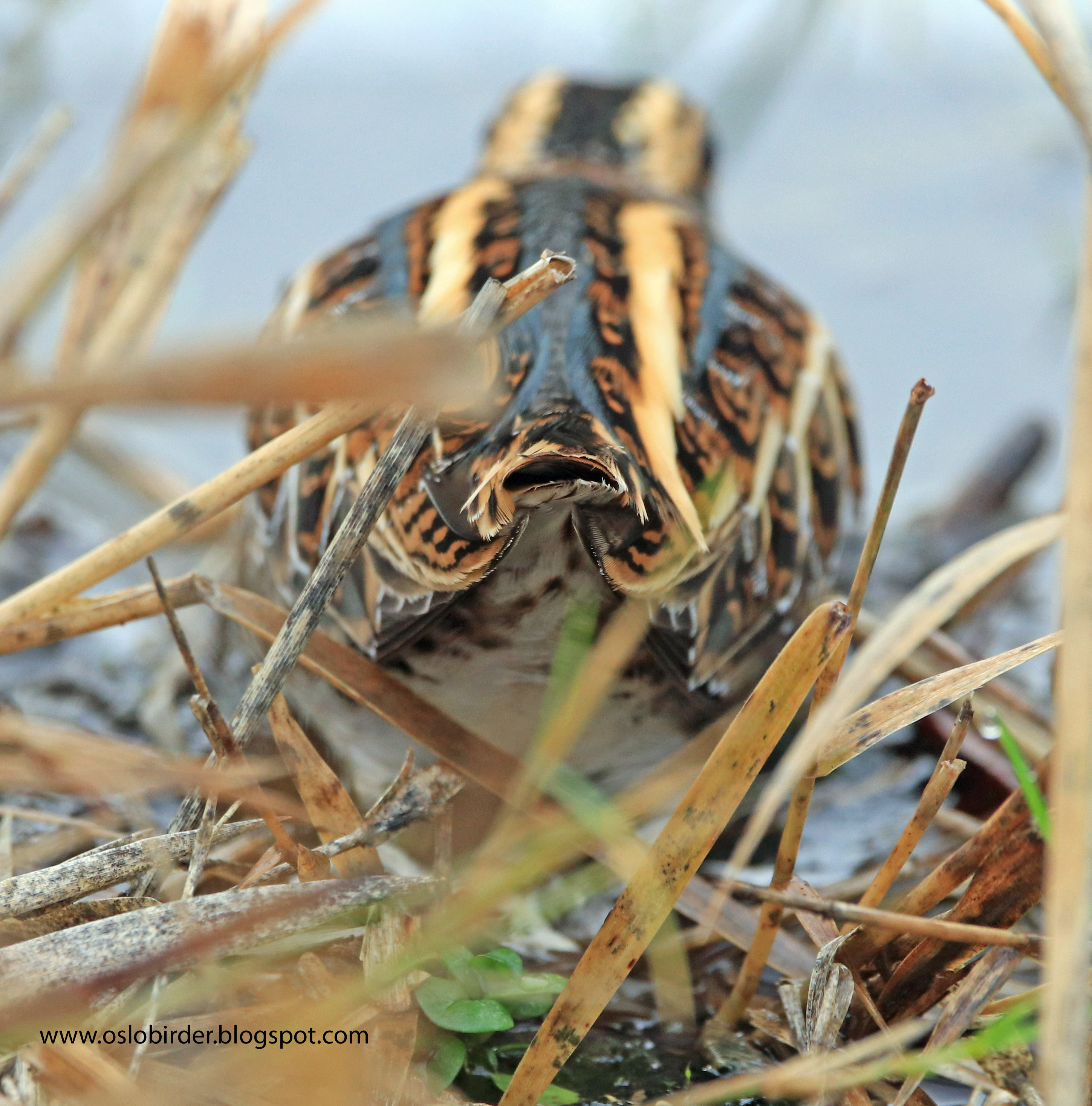
can you see the Jack Snipe (kvartbekkasin)? I'll reveal its location lower down


I love how the protruding scapulars can be moved to aid in camouflage and breaking up the outline of the bird


getting more difficult to find

and here is the location of the bird in the original picture

Wednesday, 26 November 2014

More chaffy chiffs


Another day of sun and fantastic weather with no wind and a heavy frost. I thought a walk in the forest would pay off with sounds travelling but after 2 and a half hours I realised that sounds may travel but only if there is anything making a sound. The forest was dead quiet. I checked four Hazel Grouse (jerpe) sites using sound and got no response although I did scare up one bird.
I also played Pygmy Owl (spurveugle)calls. In areas where there are Pygmy Owls then the passerines respond to the call and come to investigate and mob the owl. Therefore if you get a passerine response then you know that there are owls in the area. Well the passerines confirmed what I already knew but no owls responded or showed themselves. The passerines in question were a few tits and Goldcrests (fuglekonge) but I had no finches and the only woodpecker in the whole walk was a single Black. Definitely not a successful trip.

Maridalsvannet was without a ripple except for those made by a calling party of three Whooper Swans (sangsvane) which looked very majestic.

Heading to Fornebu I discovered that the sheltered waters were already frozen and this gave me a belief that there would be good numbers of ducks on the main fjord. Think again! I did have a few Velvet (sjøorre) and Common Scoter (svartand) but best birds were 2 Little Auks (alkekonge) and 4 Guillemots (lomvi). No divers.

I visited Hengsenga again hoping to refind the Chiffchaffs (gransanger) and record their calls. It was very frosty there but the Chiffhcaffs were still present. I had three birds (possibly four) and all were green seemingly western birds today although I only saw two well as they were feeding low in the grass. They were also quite quiet although I did hear a few “sweeo” calls indicating an eastern (abietinus?) origin. Interestingly one had a call that was (very) similar to tristis. I didn’t see the bird making the sound particularly well as it stayed in the grass nearly continually but it definitely wasn’t the grey/brown bird from yesterday and looked to have  green tones in its plumage on the back/mantle and also on the breast. There were a couple of Chiffchaffs where the calling bird was and I took a picture of the bird that I think was calling but cannot be 100% sure it is the same bird. Never-the-less the bird that was giving the tristis like call was far from what I would expect a classic tristis to look like.
I was able to record the call by taking a video. You will need to turn the sound up a lot to hear it.


I’ve made my first attempt at making a sonogram using the Raven Lite software from The Cornell Lab of Ornithology. As the recording was so poor (and I have extracted the sound rather inneficiently by using the record function on my phone) the sonogram is not, I think, good enough to tell us anything conclusive. What it does show is a pretty straightline at a frequency of around 4250Hz. 

What does this mean? Well I’m not really sure and think a better recording is needed. To my ears the sound was not quite as “sad” as a normal tristis but then again my ears are not famed for hearing subtle differences. I try to work more with these birds and my sound recording abilities. It will be very interesting to see how long they survive here. There are a few Wrens aswell in the grass and reeds so presumably there is a good supply of insects but prolonged minus temperatures will surely spell the end of them either by killing them or forcing them to move south.


This is the bird I believe was giving the tristis like call and if it wasn't then has the same look. This bird has too many green tones on the back and especially the breast sides to go down as a tristis

no obvious green or yellow under the wings but then again we don't see too much. You can see how frosty it was today
a different bird which gave a "sweeo" call but looked pretty much the same as the bird with the tristis like call. Confused? I am

Whooper Swan take off

majestic


Tuesday, 23 September 2014

Værøy 2014 day 5


The expectations for today were so much that I was up before my alarm went off (thus also and refreshingly ensuring number one spot in the number two queue) and in the field at first light. The anticipated deluge of birds had clearly not happened though and two hours in Nordland revealed there was nothing new in except for a constantly calling Goldcrest (fuglekonge) and a Dunnock (jernspurv) flying high over and calling. Just as we were about to leave for the south of the island though Kjell found a Red-backed Shrike (tornskate) and suddenly if felt like game on. Aren't we fools?!

Eight hours of slogging it around the island gave me only a sore back although I did bag five new species for the trip: Shelduck (gravand), Bullfinch (dompap), Jack Snipe (kvartbekkasin), Greenfinch (grønnfink) and Wood Pigeon (ringdue) plus a new subspecies with a very vocal although poorly seen presumed tristis (Siberian) Chiffchaff. The later helped keep the motivation levels up but the day really didn't deliver as hoped and I now only have tomorrow until 4pm to find something really good.

This being Værøy though meant there were still good birds hanging around and I did have Citrine Wag (sitronerle), Rosefinch (rosenfink), Barred Warbler (hauksanger), Y-b Warbler (gulbrynsanger), Golden Eagle (kongeørn), White-tailed Eagle (havørn), Peregrine (vandrefalk) and 100+ Ring Ouzels (ringtrost).

A Starling (stær) I came across was an amazing mimic. He was part of a group of 30 birds and was one of only two that were singing. He mimicked Whimbrel (småspove), Oystercatcher (tjeld), Herring Gull (gråmåke), Wren (gjerdesmett) and Redwing (rødvingetrost). His mimicking of Whimbrel has me seriously doubting the bird I have recorded the last couple of days on call only!
A tailess Red-backed Shrike (tornskate) was today's highlight
tristis Siberian Chiffchaff - it wasn't easy to photograph. Note it is ringed - probably here on Værøy 2 days ago


Ring Ouzel


young Golden Eagle with a squadron of Ravens


Barred Warbler

Citrine Wagtail
 
Starlings


Video of Starlings. You can here it mimicking Whimbrel, Oystercatcher, Redwing and Wren and probably some others.


Friday, 25 October 2013

Oslo the green way


With the car at the garage I chose to do Oslo by foot and public transport. As I waited to catch the tube a couple of Two-barred Crossbills (båndkorsnebb) flew low over with the wing bars visible to the naked eye and also the call quite distinct – a crossbill call with a twist of redpoll.

Encouraged by this I went to Vestre Gravland (cemetery) where there are many different types of spruce and pine which have attracted various crossbills in previous years. This time I only had two Common Crossbills (grankorsnebb) and a single Nutcracker (nøttekråke). Nearby Frognerpark had a surprising singing Chiffchaff (gransanger) and a flyover Goshawk (hønsehauk) but it is still too early in the winter for the lake to attract any interesting gulls.

Continuing down to Bygdøy the fjord was very calm and allowed me to pick out two Razorbills (alke) but most surprising was a male Long-tailed Duck (havelle) which flew inland and continued over the city. There were a few Crossbills flying over but it took me a good while before I heard the soft calls of feeding birds in the pine and spruce trees. It took me a good while longer to locate a bird and what helped was a couple of cones falling to the floor. I picked up three birds and the only one which I could see well was a male Common Crossbill.
male Common Crossbill (grankorsnebb). This bird revealed its presence when the large cones fell on the floor

I then heard the a very distinct trumpet call and was sure it was a Two-barred Crossbill (I had previously heard a Bullfinch giving its version of the trumpet call but this was very different). I had to walk a bit through the forest but soon located the tree where the bird was calling but couldn’t see the bird!! I did locate a crossbill but this was a male Common Crossbill. I couldn’t see this bird actually calling but neither could I detect another bird in the tree. The calling then stopped and I took a couple of pictures before the Common Crossbill flew off giving a normal call. I waited around but there was no evidence of there being another bird in the tree and I didn’t notice/hear another bird flying off. I am therefore left with either The 2 Bird Theory, a Two-barred Crossbill lacking wing bars or a Common Crossbill with a trumpet like call. I think I would have heard if there were two birds as crossbills are quite vocal when they fly off. A 2BC without wing bars – yeh right. So I’m left with a trumpeting Common Crossbill.

I managed to record the calls with my phone which are just about audible above my rustling and the sound of the camera as I took photos of the Common Crossbill. In the field I felt that the trumpet call was spot on for 2BC but what I can hear on the recording doesn’t sound quite right.


I have found a recording of Common Crossbill from Italy that sounds close to what I recorded:


Here is a "good" 2BC:


Maybe it is just me and the "trumpet like" call is actually a regular call of Common Crossbill but it certainly had me going.


Also in the forest Crested Tits (toppmeis) and the smallest Goshawk I have even seen, It was a juvenile making its identification easy but if it had been an adult I would have struggled to separate from a female Sparrowhawk based on size alone.

juvenile male Goshawk (hønsehauk)

the vertical stripes of juvenile Goshawk separate it from Sparrowhawk

I also had Waxwings (sidensvans) at various places today so they are arriving in force now.


Yesterday a trip to Fornebu gave a brief view of a silent Chiffchaff that looked like a tristis plus a Blackcap – so there are obviously still some warblers around.
hazy picture of a probable Siberian (tristis Chiffchaff)