Showing posts with label Broad-billed Sandpiper. Show all posts

Friday, 30 May 2025

Holiday driving

Yesterday was a bank holiday in Norway and Jr and I used it to take a looooong drive. She takes her driving test on Monday and is keen to get in driving practice and I have places I want to bird but no longer find the long drives much fun. It is therefore a win win if I get chaffeured and Jr gets the practice she wants. We were out 13 hours and clocked up just shy of 600km. The destination was a first trip to the mountains for the year. Not Beitostølen / Valdres but Ringebu which I have developed a taste for.


First stop was to check out a Tengmalm’s nest that Per Christian and I had discovered in April. No bird showed and I am really beginning to think it is my trunk scratching technique that is the problem rather than there never being owls in the holes. A very small and rare butterfly was a good compensation though with a few violet copper (fiolett gullvinge) on the road verge. I have previously found a very healthy population a couple of kilometres away and this very normal looking area of open pine forest clearly holds good numbers of what otherwise seems to be a declining species.


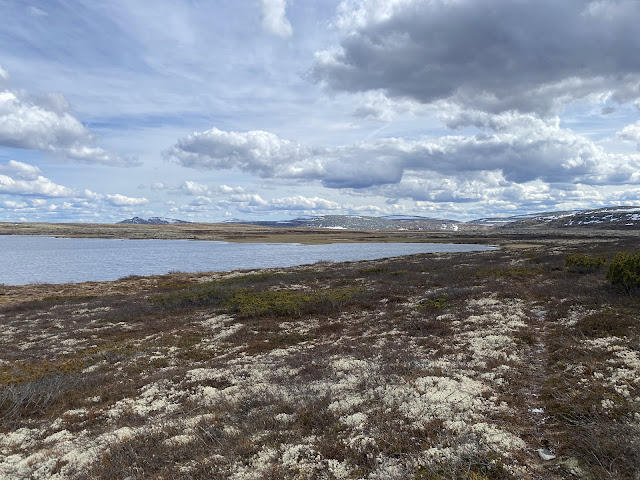
After this we headed higher and above the tree line. There was no snow but it was all very brown and the birches on the tree line were yet to come into leaf. The lake and marshes I was headed for were ice free and there were quite a few birds but clearly a number of migrants are not back yet. Although there were fair numbers of Yellow Wagtails and Meadow Pipits I found no Bluethroats, Lapland Buntings or Wheatears which should be numerous. There were also no raptors, owls or grouse so it is clearly not a rodent year in these mountains.


Waders were back though. My target was Red-necked Phalarope and two pairs were probably only just in. Redshank, Wood Sandpipers, Golden Plover were also all on territory and there were 3 or 4 calidris waders in song flights at some distance that gave me a bit of a headache. When I initially heard the «song» I identifed them as Broad-billed Sandpipers but then I started hearing Dunlin and a Dunlin landed close to me. I assumed they were all the same species as they were flying around together and then started thinking I had misheard and they were all Dunlins.


Lucky though I did take some terrible distant photos and there were clearly both species flying together. I now wish I had walked further into the marshes (my feet were already wet anyway) and tried to see them properly.

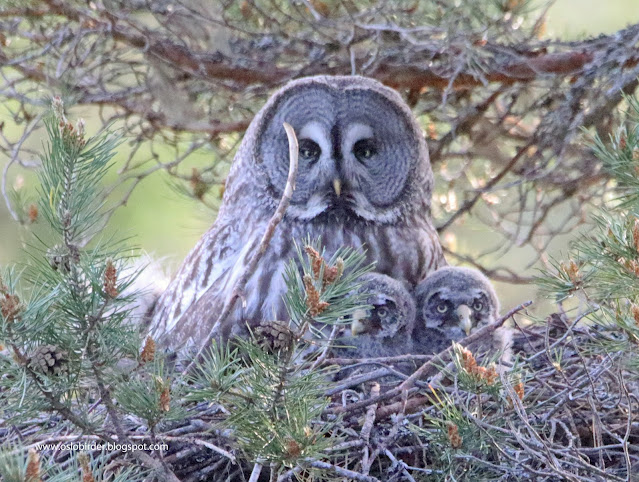
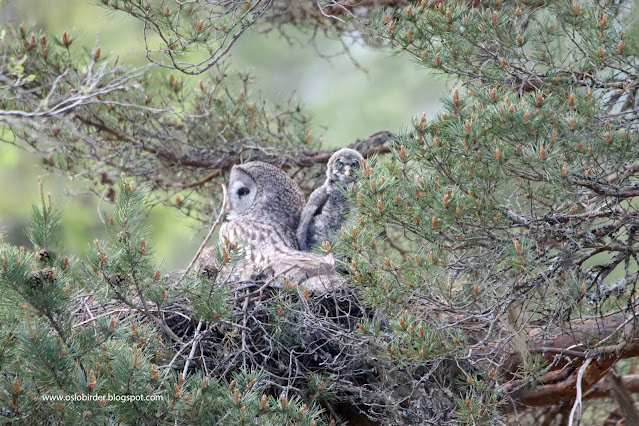
After this we needed to get some food and headed for Elverum where after a McD we then visited Norway’s only known singing Ortolan and then the GGOs. This time we had to wait over an hour for a feed but it was fun watching mum and the young getting increasingly hungry and impatient. Then driving home we had a roadside GG hunting in someones garden 😊


Today, a post on Facebook reminded me that it was about time I twitched a butterfly. Scarce Heath (heroringvinge) is rare in Norway but occurs on a couple of islands (one of which is connected to the mainland) only 6km from Fornebu. They were easy to find and the habitat - some open ground backing onto gardens - looked very ordinary. This species seems to be extremely sedentary and although it can be well established in one small site seems unable to expand onto other sites just a few hundred metres away.


I’ll post pictures now and will come back with videos which should be good although knowing me I will have failed to press the record button when I thought I had.


a male Red-necked Phalarope (svømmesnipe)

and a female. This is one of the very few species where the female is the more colourful of the sexes

habitat

Dunlin (myrsnipe) and Broad-billed Sandpiper (fjellmyrløper). I regret now not trying to get closer to the area they were displaying over


size difference is just about possible to make out


Norway's only known singing Ortolan Bunting and the same bird I found on 10 May. Nothing suggested he had found a mate


Great Grey Owl (lappugle) watching. I should have some good video


the three young are growing and the two oldest are now grey instead of white. The third and smallest is just visible to the left of the other two behind the branch

one young was hiding under mums wing

and then climbed on top of her

male Violet Copper (fiolett gullvinge)


and the subject of today's twitch a Scarce Heath (heroringvinge)


Monday, 26 May 2025

Three Great Days

The last three days having been shockingly good!!

All you need is some rain and then the wind to change to southerly and boom.


Fridat started naturally in Maridalen where 19 Temminck’s are yet another record but stubbornly refuse to attract any other calidris to join them. On Thursday though I finally had Greenshank there and 4 Golden Plovers so this springs wader list is very respectable and on Saturday 4 Redshank also dropped in. A short visit to Østensjøvannet gave lots of feeding hirundines in the cold northerly wind which was nice to see after a couple of years where an insect absence has meant there has hardly been any there. House Martins were the scarcest and I am worried about this species. Black-headed Gulls continue to suffer and I could see just 2 nests still occupied. Highlight was a pair of Garganey found by Jack the day before and excitingly their behaviour suggested to me they will try to nest.


After this I announced to anyone who wanted to listen that I was off to Nordre Øyeren to find a Broad-billed Sandpiper and that turned out to be a good prediction😊. I stopped first at Merkja where the american Green-winged Teal is back and a good selection of waders included 18 Temminck’s (still beaten by Maridalen). Svellet again had absolutely no waders but it was Årnestangen where the excitment was. A Bar-headed Goose on the walk out was a tickable piece of category C plastic after the Norwegian records committee has recently «upgraded» it from pure plastic category E.

The real action was to be had at the end though where an initial sweep of the dry mud flats revealed nothing… but a second sweep showed a wader walking around the corner from an unviewable bit of shoreline. Eventually a few others joined and they turned out to be 4 species with a Broad-billed headlining, 11 Sanderling being a very high spring count and 2 each of Dunlin and Ringed Plover being more expected.


But that was only the beginning of the day! In the evening I was guiding to GG Owls. This allowed me to take in a Caspian Tern at Hamar and then the owls completely outdid themselves with the male bringing 3 voles in the course of just an hour which mum fed to three hungry chicks. Happy days!!


So, after such a long day I could be forgiven a little lie in yesterday morning on what had all the hallmarks of being THE day this spring with rain and strong southerly winds forecast. I decided to allow others the joy of walking out to Årnestangen and instead went first to Maridalen where 19 Temminck’s were still present and now even displaying and 3 Greenshank and 4 Redshank were new. I reckoned it was sea gazing that was the best option today and positioned myself at Halden Brygge, Fornebu from 10:30 where a kiosk provides great shelter when it blows from the south. A flock of 30 Oystercatcher heading north as I got out of the car was a promising sign and then a minute later the sight of a flock of 21 Kittiwake was a sure sign that birds were moving. This flock headed north over the city and then a bit later a new flock of 23 came from the south and eventually landed on the water. Red-throated Divers were moving high up with 141 in total and I grilled every tern I saw with all being local Common Terns until suddenly the closest tern of the day turned out to be a Sandwich. This was big - finally after 24 years by far my biggest bogey bird in Norway had fallen😊 and I even got photos. It was heading south and as I watched it a large flock of Brent Geese came into view heading north!! It was all a bit too much. These were pale-bellied birds which usually fly up the west coast of Norway on their way to Svalbard but occasionally take a wrong turn and head up the east coast. They were obviously very confused and eventually turned around and headed south again. After this there were some smaller flocks including one which did head north and I last saw it heading over Maridalen.


Today has been a wet day but I have of course been out. In Maridalen rising water levels and a night with no rain had caused all but 3 of the Temminck’s to move. The fjord didn’t seem to have any interesting birds with the wind having turned easterly and rain making visibility bad. So Nordre Øyeren beckoned. I chose not to walk out to Årnestangen after Svellet only had 8 Temmincks to offer but Merkja had the goods with 2 Mountain Marsh Runners having already been found and feeding alongside Dunlin and Temmincks with the Green-winged Teal also still present and showing well😊


Here are videos and pictures of everything bar the GGO which I will have to come back to.


finally - Sandwich Tern (splitterne)!! and I found it myself :-) 


sea gazing from Halden Brygge


confused Brent Geese (ringgås) over Oslo

here we see they are the Pale-bellied subspecies

I have not counted but reckon they are around 300

Kittiwakes (krykkje)

female Garganey (knekkand) giving unusually good views

male


Caspian Tern (rovterne)

these are probably my best views in Norway much better than the Svellet experience


Bar-headed Goose (stripegås) with Canada Geese and a Canada x Greylag hybrid

a Dunline (myrsnipe) and Broad-billed Sandpiper (fjellmyrløper) - trust me!

Sanderlings (sandløper)


Green-wnged Teal (amerikakrikkand) with normal Teal


quite a collection of birds at Merkja

a male Ruff (brushane) with 4 other wader species

Temminck's Stints 

the Broad-billed Sandpipers at Merkja were much close than at Årnestangen but I still failed to get good photos

2 Mountain Marsh Runners with a Temminck

Dunlin and Temmincks

Green-winged Teal


Tuesday, 27 June 2023

Broad-billed Sandpipers and friends of the mountain marsh

Time now for the first instalment of my 24 hour birding and butterflying trip to the mountains and forests north of Oslo last week. The spur of the moment trip was spurred by the seemingly easy chance of seeing displaying Broad-billed Sandpipers accompanied by warm, sunny weather. I have seen quite a few BBS on passage and have seen them twice on their breeding grounds including once very closely but I have never seen or heard them displaying and it was almost bucket list desire. They normally breed on quite large and inaccessible bogs but evidence I had been sent to my phone suggested that the birds Per Christian had seen was anything but inaccessible. The location was a marsh at over 1100m and consequently way above the treeline which was not how I have pictured the preferred habitat for this species. The area is known to hold a number of other birds including Red-necked Phalaropes and my plan was to spend the night and experience lots of activity very early in the morning. I arrived in the early evening though and with it never getting truly dark I was able to bird straight away and to be honest hit the jackpot before bedtime.

The BBS did not quite live up to my expectations but I had it in its display flight on a number of occasions including low over my head but I never got to see it properly on the ground. Every time it finished a display flight it would plummet down into the marsh only about 20m from where I stood but then it would just vanish. Only once did I glimpse it on the ground and I think it was living up to its Norwegian name of Mountain Marsh Runner (fjellmyrløper). This video has a bit of its display flight including song.


Broad-billed Sandpiper (fjellmyrløper) in display flight


flight shots aren't getting any easier


Red-necked Phalaropes showed a lot better although it took me a long time to see them closely although they then performed very well. Although I think some birds had settled down to nest there was a group of females flying around, calling and seemingly looking for unpaired males.


female Red-necked Phalaropes (svømmesnipe)


at sunrise

do you see it?


Lapland Buntings were also present and 4 singing males makes this one of the best localities in southern Norway of a species that is declining fast. A lack of rodents meant that a single Kestrel was the ONLY raptor or owl I saw.

male Lapland Bunting (lappspurv)


male Willow Grouse (lirype) in a place where the white feathers really help it blend in


Wood Sandpiper (grønnstilk)

male Grey-headed (Yellow) Wagtail

even this bird has a hint of a white supercilium

trying to be arty


on a lake on the tree line at 965m a pair of Slavonian Grebes showed well


sunrise 04.01 at 1130m

also 04:01

04:17