Showing posts with label Green Woodpecker. Show all posts

Thursday, 27 February 2025

Fools and birds


Guiding is a fool’s game!


On Tuesday, 6 hours and 11km of walking in a foggy Maridalen with Wayne over from Guernsey could only turn up a Three-toed Woodpecker. Next day the Hawk Owl is back in its favoured place….


Three-toed Woodpecker - the highlight of a hard going days guiding

Hawkie of course showed the next day

Moose was a target when guiding and we saw lots of fresh droppings and footprints in the snow but no animal. We did see where one had fallen through the ice though...

Wednesday night 3 hours owling with Tommy and Maja gave just 2 very distant heard only Tengmalm’s and a very close Tawny that refused to perch in the open. I plan to go again on Friday with Jr and of course wouldn’t be surprised if there are owls galore…. It was cloudy on Wednesday night but little wind and was warm at +2C. I normally only go owling on cloudless nights so this may be the key factor (Friday is forecast to be cloudless).


Video of the Tawny Owl hooting including its Hawk Owl like warbling. We initially heard the bird from close to 1.5km away


Birding outside of guiding has been good though with my first Skylarks, Snow Buntings and Whooper Swans of the year. Best of all though was a pair of White-fronted Geese with the first Greylags at Bygdøy. I went there specifically with White-fronts in mind due to a few turning up further south so was mighty chuffed to find them.


White-fronted Goose (tundragås) with Greylags


there is little flooding currently at Hengsenga, Bygdøy and the weather forecast does not suggest we will get a big flood like last year

Snow Bunting in a still snowy Maridalen


and my first Skylark of 2025

The male King Eider (praktærfugl) seen from Huk at a distance of around 3km

Long-tailed Tit (stjertmeis)


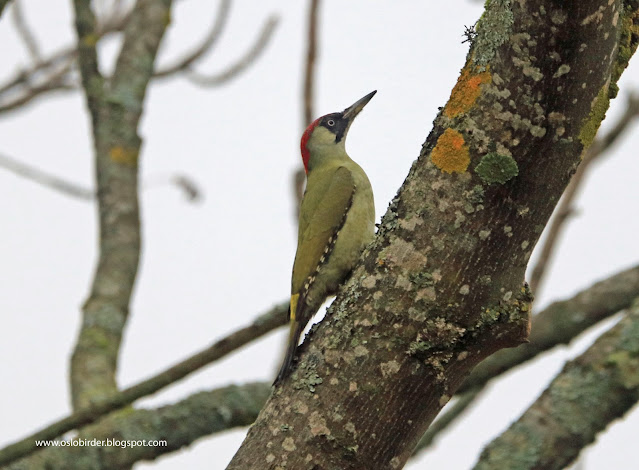
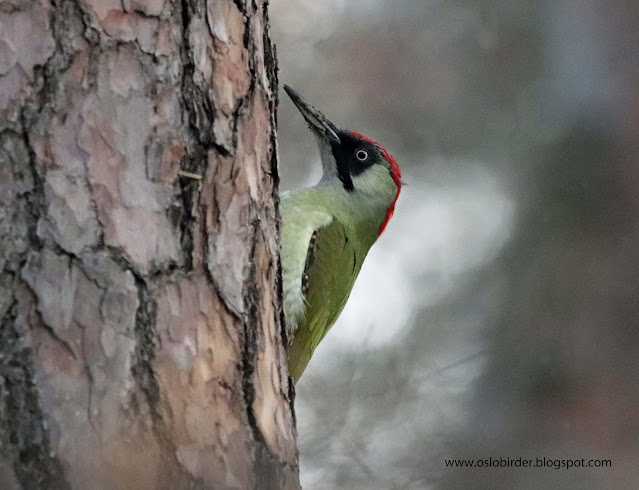
a yaffling male Green Woodpecker 


Friday, 2 February 2024

Brunnich's Guillemot

On Wednesday I had that much anticipated and rarely occurring event that is an Oslo tick. Never-the-less it didn’t leave me feeling in an especially celebratory mood because the views were not that great and the photographic evidence leads much too be desired. The bird in question was my first Oslo Brunnich’s Guillemot. This is a species that breeds in the far north of Norway but is a very infrequent sighting anywhere in the country away from the breeding sites as its wintering areas are far out in the Arctic Ocean. On Wednesday the fjord was very calm off Huk, Bygdøy and lots of ice had formed. The result was that birds were easy to see on the sea and also concentrated in a smaller area than normal. The recent southerly winds had pushed in quite good numbers of Guillemots which were now easily outnumbering the Razorbills which had previously (and unusually) been the commonest auk this winter. Most of the auks were resting in small groups on the open water but a few were feeding on their own amongst the ice. One of these birds, and a relatively close one, immediately caught my eye as it had a lot of black in the face. I had already noted an adult Guillemot in summer plumage (most of the birds that get pushed in are immatures that do not acquire summer plumage) but this bird was different. It was a stubbier, more angular bird than a Common Guillemot and seemed to have cleaner, white flanks. This was interesting and my thoughts went immediately to Brunnich’s. I cranked up the magnification on the scope and immediately felt able to confirm that it was one even though range and lighting were not the best. I could just about make out the diagnostic white line over the short bill but in the only picture I managed that shows the bird in any way that might approach a record shot it is not visible. It started diving and swimming away from me and joined a small group of Common Guillemots on the open water. This group contained an adult in summer plumage and he Brunnich’s was clearly separable even at long range due to its different jizz with a shorter bill and more angular head. Also the white flanks (lacking obvious barring) were visible.

So, a tick but not of the “here look at my great picture of it” variety.


In Maridalen Brambling was a new bird for the year and the Grey-headed Woodpecker turned up again after an absence of 3 weeks or so and finally showed in nice sunlight. I also saw my first Green Woodpecker of the year (had previously only heard them calling) with a “singing” female. With all the snow I have been looking for mammal tracks in the snow. I have seen numerous Moose and Roe Deer, Red Squirrel, Beaver, presumed fox and Pine Marten. Pine Marten is a species I have only ever seen once but I think is a reasonably common species around Oslo and perhaps even in the city.

Brunnich's Guillemot (polarlomvi)...

Maridalen's female Grey-headed Woodpecker (gråspett) with the red feathers in the crown is still here


and a female Green Woodpecker (grønnspett)

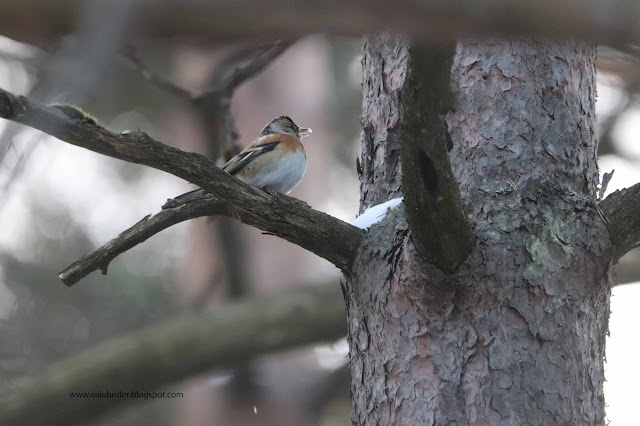
my first Brambling (bjørkefink) of the year

and some Bullfinches (dompap) which seem to be very numerous this winter

tracks of Pine Marten (mår)


and droppings


and some random shots of Maridalen in the snow


Monday, 17 October 2022

Good autumn day

 This weekend I have been a good citizen / parent and have worked pretty much all the daylight hours at a second hand market at the local school. This is all part of being a good Norwegian and is how the richest country in the world funds music at its schools (don’t get me started…). Whilst I was stood in the rain (I was lucky enough to be working outside..) messages kept pinging on my phone confirming that the Dusky Warbler was still present although it was just as skulky as when I found it and no photos were managed so I will have to write that description.

This weekend also saw one of the best Norwegian twitching stories that I know of. A Barn Owl (extreme rarity in Norway) was found last week on the island of Store Færder (where I was in the beginning of September) and a carload drove from the Stavanger area over night, got a boat out to the island and dipped the bird despite it having been in the morning. Then when what is probably the same bird was seen by a single observer on Saturday on the nearby mainland and they drove over night again and this time scored and saw it with thermal bins before dawn (no local birders/twitchers have managed so connect so these long distance twitchers deserve their tick!).


Today was started off as a fantastic autumn day with no wind and cloudy skies. I thought that Fornebu could come up trumps and if I didn’t find a major rarity (as if) then there should be something good like perhaps a Bearded Tit which have just started their autumn irruptions from breeding sites further south. There were clearly lots of birds on the move with 4 flocks of Waxwings, Twite, a late White Wagtail and Meadow Pipits plus other finches and thrushes but surprisingly no Chiffchaffs (of any race). I picked out a single Jack Snipe with the thermal camera (I’m getting rather hooked on it) and best bird was a female Grey-headed Woodpecker which I picked up on call and then got to see very well in the same area as a couple of Green Woodpeckers. This is my first record of the species at Fornebu.

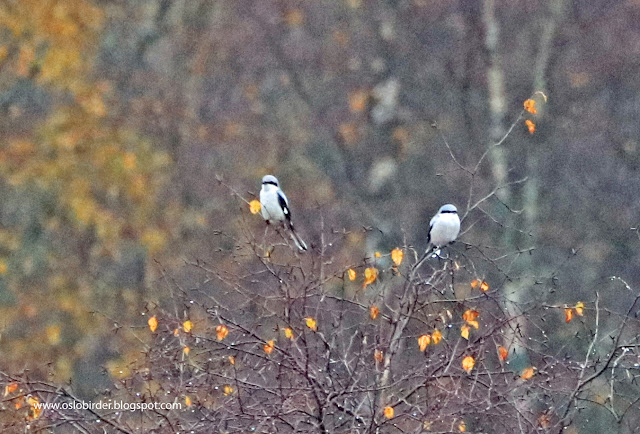
A quick check of Maridalen revealed two Great Grey Shrikes together in the same tree and they looked to both be adults so were perhaps a pair that has left their breeding site together.


Here is my eBird checklist from Fornebu.

Grey-headed Woodpecker (gråspett). The lack of red on the head shows this is a female


and a Green Woodpecker (grønnspett). The all black mustache (lacking red) shows this is also a female

Waxwing (sidensvans)


2 Great Grey Shrikes (varsler) in Maridalen


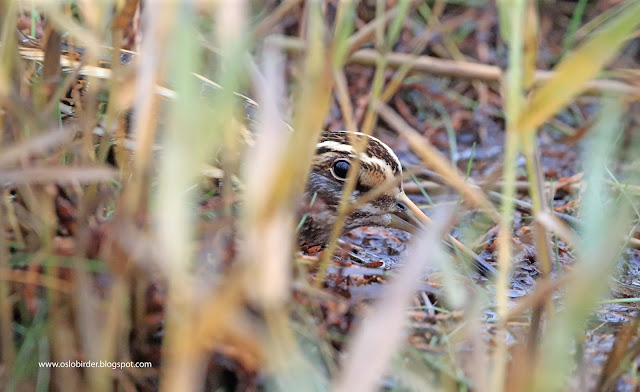
Jack Snipe (kvartbekkasin)


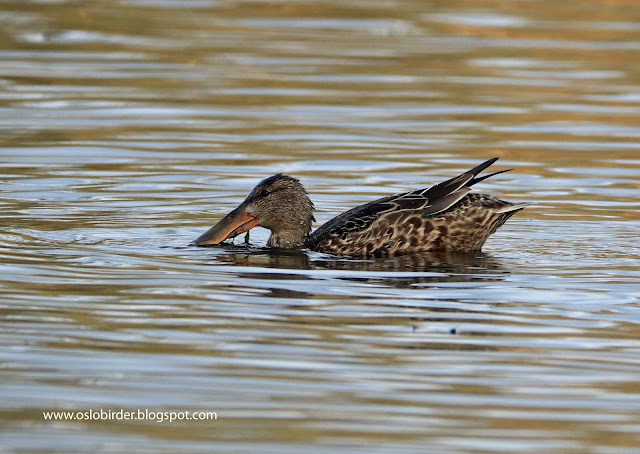
Shovelers (skjeand) from Friday at Østensjøvannet


Wednesday, 8 December 2021

Urban Pine Grosbeaks

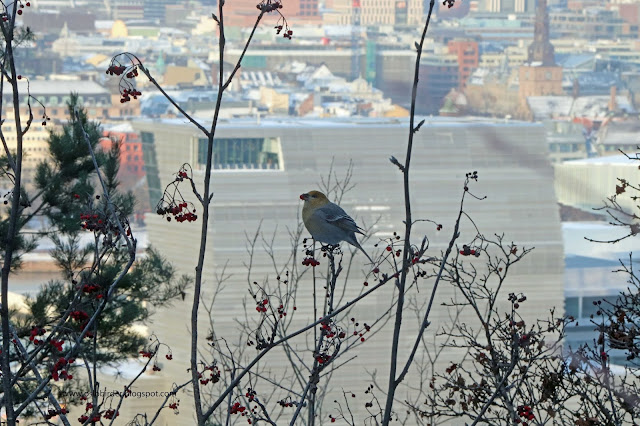
I am having to fit my birding in around other things at the moment which has made me focus on some more urban areas which I can easily visit when I have some time available. On Monday I went to the sculpture park at Ekeberg for the second time this winter to see if there were any Grozzas there. This area and its plentiful rowan berries proved very popular to Pine Grosbeaks in Nov/Dec 2019 but apart from a single bird I saw on 3 Nov there have been no other reports this winter (although I don’t think many other people are looking). What is cool about this location is that you are on an escarpment with the city below you so can have an interesting backdrop to your views (and pictures) although it is so steep in places that you also have to look down and mind your footing.

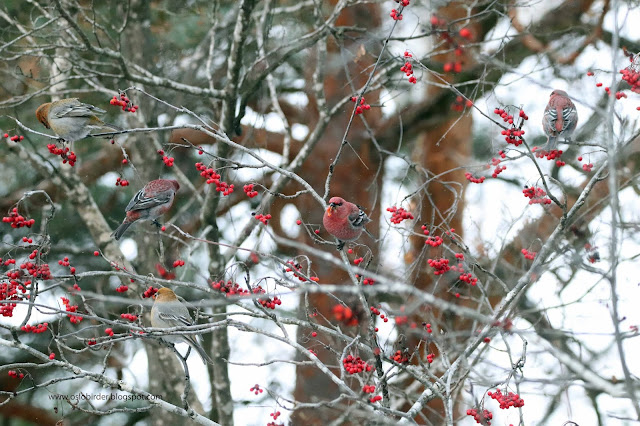
On Mondays I did indeed discover Grozzas with a minimum of 21 birds including 5 adult males. One group of 14 contained 4 adult males and such a high ratio suggests to me that these birds may have come from a new wave of birds as I have previously only seen one flock this winter with a comparable ratio of adults. It was of course wonderful to see these birds and as usual they showed at close range. There were also many Fieldfares and a few Redwing in the area (but still no Waxwings) and the thrushes were frequently flying around in a stressful manner so I assume a Sparrowhawk was in the area. When this happened the Grosbeaks would just freeze without making a noise and would keep the same position for a number of minutes before feeding again. They only time they would fly and call was if they were disturbed by a man made noise.

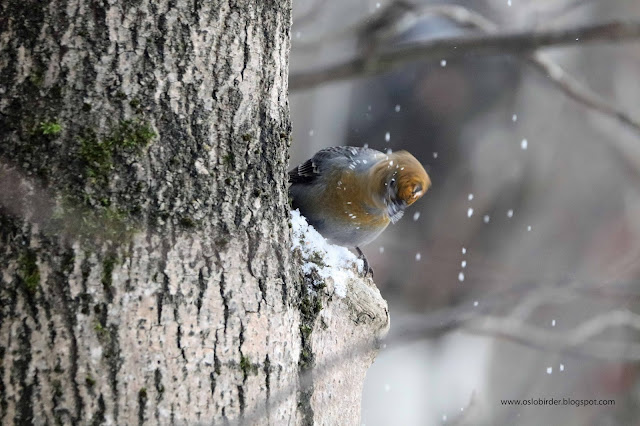
I also saw the Grosbeaks frequently eating snow either on the ground or that they found in the trees.

In addition to all the thrushes, and Redwing in December are rare, there were a good number of other birds including Bramblings, Hawfinch, Goldcrests and Green Woodpecker so it was surprisingly birdy for a cold December day.

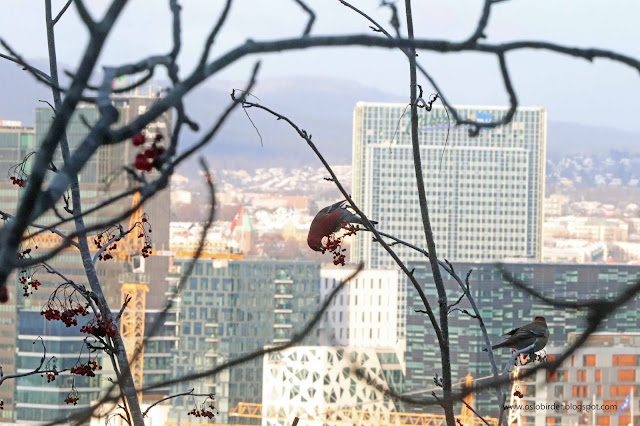
First some pictures with the city as the backdrop


the enormously expensive and nearly universally disliked Munch Museum provides the backdrop


Oslo and Norway's two highest building plus the so called Barcode


and just the birds


3 adult males in this shot

eating snow and having a shake


Brambling (bjørkefink)

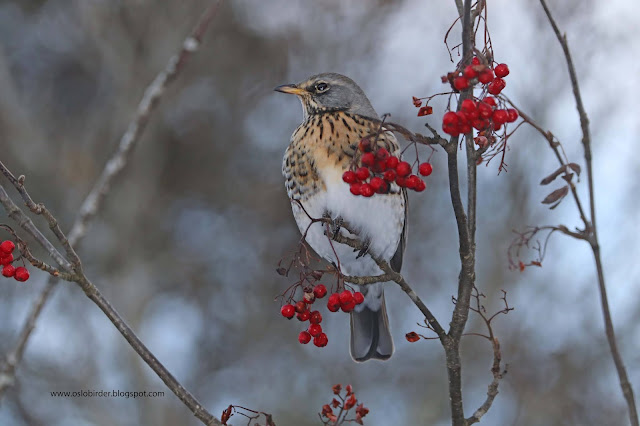
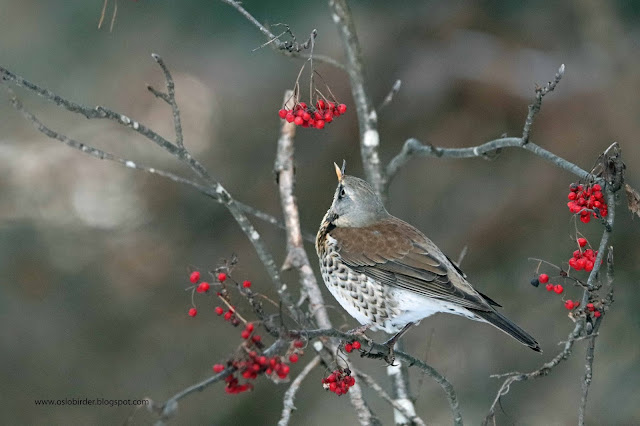
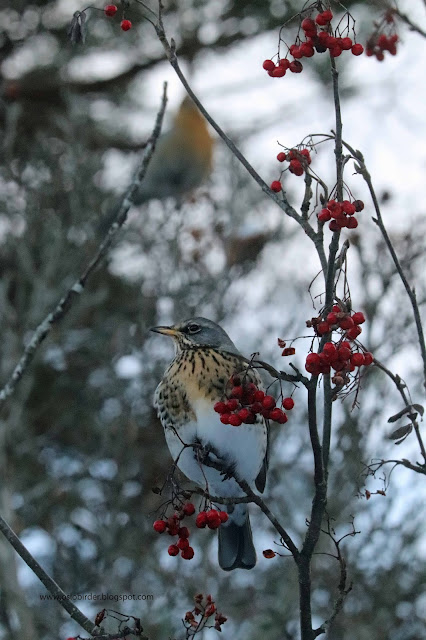
Fieldfare (gråtrost)


this particular bird had a broken upper mandible that wouldn't close but it didn't stop the bird eating berries


Fieldfare with Pine Grosbeak behind

Green Woodpecker

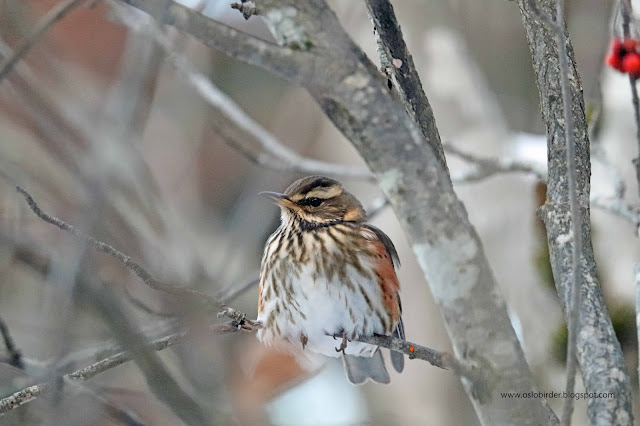
Redwings (rødvingetrost) are rare in December but the plentiful supply of berries has clearly encouraged a few to stay


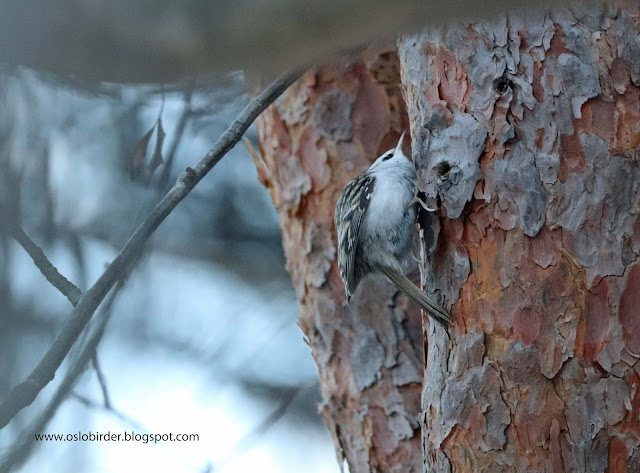
Treecreeper (trekryper)