I felt a need to post, no matter how briefly, a few days ago as a very close friend of min recently took his own life and it has been a very strange and emotional time and a reminder to me of the need to communicate. Birding has been, as it always is, a good way for me to keep myself in balance and I have not been spending time in front of the computer or editing photos.
I have this evening found a few more photos and videos from the last week in Maridalen which show a bit how things are there. Autumn migration is starting and the hope is always for something very exciting to turn up although currently I am more aware of the breeding birds disappearing.
adult Black-throated Divers (storlom) on Maridalsvannet. The single small juvenile that was on the lake earlier in the summer has disappeared but up to 11 adults have been on the lake
In this video of Red-throated Divers (smålom) which have not bred on Maridalsvannet but have now moved here from their nearby breeding ponds you can see a juvenile that is begging for food by stroking its parents throat with its bill
a visit to Svellet with Jr Jr to give her some driving practice (her driving test is coming up) looked like it would be very promising but there was no birding gold at the end of the rainbow
a caterpillar of a Pine Hawk-moth (furusvermer) Sphinx pinastri
and the caterpillar of Elephant Hawk-moth (stor snabelsvermer) Deilephila elpenor shown in the video in my last post. I found both of these wandering on roads and they are searching for places to turn into a pupa
Just in case anyone was worried and wondering if I am still here then yes I am 😊
This very short post doesn’t feature a single butterfly, although there is a caterpillar of an Elephant Hawk Moth (stor snabelsvermer) which is a quite fascinating creature.
This video of things that I came across the last couple of days also shows you what I have basically been spending all my available time watching and documenting since coming back to Oslo at the end of July.
The last two days have been promising in Maridalen:
the first flocks of Pink-footed Geese have migrated north and on the fields I
finally caught up with Snow Buntings (others have been seeing them for a few
days) as well as having my first Linnet and Reed Bunting of the year.
Chaffinches are now all over the place, 3 Lapwings are back and with
temperatures reaching double figures in the afternoon spring feels like it has
sprung.
Last night I took Conor owling and we heard Pygmy
Owl, Tawny Owl and Tengmalm’s Owl although activity was very low which
surprised me as conditions had seemed perfect although it did cloud over which
may have been the nail in the coffin.
male Snow Bunting (snøspurv)
the same male in the front and a presumed female behind
Goldfinch (stillits)
my first Lizard of the year
Two Buzzards (musvåk) in Maridalen
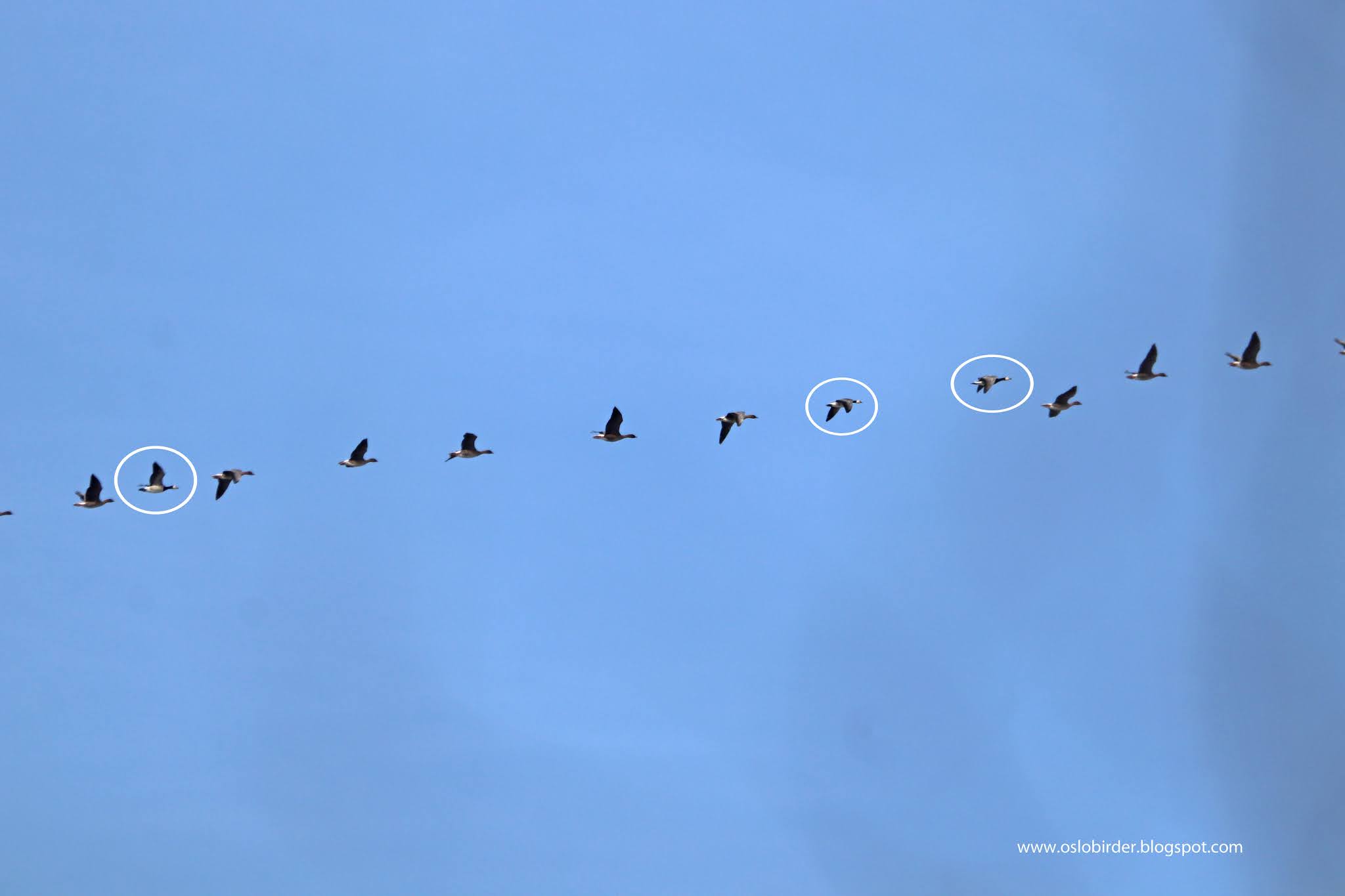
A flock of Pink-footed Geese (kortnebbgjess) heading north with 6 Barnacle Geese amongst them. These are probably proper will Barnacles on their way to Svalbard and it has become more common over the last few years to see Barnacles amongst the Pink-feet although the normal migration of Svalbard Barnacles is much later.
3 of the Barnacles
and a close up of one of the Barnacles with 3 Pink-feet
a caterpillar of Ruby Tiger Moth (rustvingespinner). The species overwinters as a caterpillar and they emerge early in the spring and then look for a suitable place to pupate
Yesterday saw fairly good weather and a walk with Beast in Maridalen revealed a few odonata with the first Darters of the year now on the wing. Butterflies though were limited to many whites in active flight over a crop field with the only one I saw well enough to identify being a Green-veined (rapssommerfugl). A nettlebed was alive with Small Tortoiseshell caterpillars though.
On the lake a family of Black-throated Divers with two small young suggests a new and late nesting attempt as there was no suggestion that the initial attempts by either pair had been succesful with changing water levels being the likely culprit. Six adult Red-throated Divers were made of a group of 4 vocal birds who were I assume failed or non-breeding birds whereas two others including one in flight looked more like birds finding food to take to young on a distant pond in the forest.
A scolding Marsh Warbler indicated young nearby and a male Red-backed Shrike had at least one begging youngster in tow.
One doesn’t need to take lunch into the field at the moment with enormous quantities of wild raspberries and mushrooms although blueberries are scarce around Oslo this year.
Today the rain took me to Nordre Øyeren and Årnestangen. There is now also some mud in Svellet and this also held good numbers of waders. In total I had 19 species of wader with three new species compared to Sunday (Spotted Redshank, Oystercatcher and Lapwing with just Golden Plover absent today). Totals of interesting species were 27 Grey Plover, 12 Barwits, 6 Knot, 4 Ruff, 5 Curlew Sands, 5 Sanderling, 119 Dunlin (all adults still) and 2 Spotted Redshanks.
An afternoon trip to Ikea where I spent more time queuing to get in (50 minutes) than inside allowed me to check the fjord at Fornebu on the way home. A summer plumaged Guillemot and a Pink-footed Goose were most unexpected.
Pink-footed Goose (kortnebbgås), Barnacle Geese (hvitkinngås) and Greylag Geese (grågås)
adult summer plumaged Guillemot (lomvi) which is not expected offshore Oslo in July
Nutcracker (nøtekråke) in Maridalen yesterday. This bird had mu on its bill and had probably been burying hazel nuts
and a juvenile Red-backed Shrike (tornskate)
Small Tortoiseshell (neslesommerfugl) caterpillars
I braved Fornebu again today this time in sunny conditions
and was rewarded by a nice selection of scarce birds. I don’t think any new
birds had arrived and indeed most of the Yellow Wagtails had moved on but the
warm weather and increased insect activity just made the birds more visible as
they fed out in the open.
Pretty much the first bird I saw was a Wryneck which was
sunning itself in the dead bush normally favoured by a Red-backed Shrike and
later in the morning the Wryneck had been substituted and a shrike was in the same
place. Tw of my all-time favourite birds in the same bush means the birding day
has been a success. In the same small area were 3 Redstarts, 4 Spotted
Flycatchers and 4 species of warblers so it felt very good and spurred me to
check the rest of Fornebu with high hopes only to find out that the small area
held nearly all the birds there were to find!
On the water in Storøykilen I saw the Little Grebe that has
been present for a week or so and in the reeds I heard the Water Rails calling
so tried to see them. I settled down in a good place and waited. I had two
birds (possibly three) calling very close by but only managed to see one bird.
It was actually quite close but the encounter was so brief that I just managed
a blurred photo.
A short stop in Maridalen gave me just a single raptor but
it was a new one for the autumn namely a Kestrel.
Wryneck (vendehals) with a curious Willow Warbler (løvsanger)
Wryneck
Red-backed Shrike (tornskate)
same shrike
Reed Warbler (rørsanger). note long primary projection and weak supercilium compared to the Blyth's Reed from Maridalen
my first migrant Chiffchaff (gransanger) of the autumn. Note the short primary projection compared with the Willow Warblers I have photo'ed recently. This bird also pumped its tail a lot which is a good Chiffchaff character and first drew my attention to it
a blurred Water Rail (vannrikse)
Wheatear (steinskvett)
very distant Little Grebe (dvergdykker)
Three Greenshanks (gluttsnipe)
yet another caterpillar of Bedstraw Hawk Moth (hyles gallii) (mauresvermer). Note the ant hitching a lift
My first Kestrel of the autumn in Maridalen with three Swallows mobbing it
I managed short trips to Maridalen and Fornebu today in
overcast conditions and really noticed how few Willow Warblers there are. At
this time of the year this species should be in every bush but I could not have
had more than 10 during the whole day. I have been hoping that the low numbers
are due to breeding being delayed due to the late spring but now I fear that
breeding success has just been catastrophically low and there are very few
young birds around. I also had no Bluethroats today which I had hoped to find
although it is still early days for this species.
Not all insect eating species seem to have had a bad season
though. Swifts (tårnseiler) and Swallows (låvsevale) seem to be abundant as are
White Wagtails. Red-backed Shrikes also, and surprisingly, seem to have had a
good season and in addition to the 3 young birds still in Maridalen I had three
youngsters at Fornebu. Two Redstarts and a Pied Flycatcher were unusual autumn
migrants to find at Fornebu and maybe these species have also had a god year.
In Maridalen I glimpsed a Honey Buzzard and heard a Redshank
which is an unusual autumn record here.
one of the Red-backed Shrikes (tornskate) at Fornebu
Redstart (rødstjert) at Fornebu
can you see the 3 wader species in this shot from Storøykilen, Fornebu?
Lesser Whitethroat (møller) and Whitethroat (tornsanger) from Fornebu
this newly fledged Blackbird (svarttrost) was still being fed by mum. It is quite a late date but the mum had a very easy job collecting food. They were sat in a berry tree and she just collected berries and dropped them in juniors open mouth
I'm not sure which species this caterpillar will grow up to be but is I assume a moth rather than butterfly. A google search of "caterpillar red spike tail" suggests it is a Bedstraw Hawk Moth (hyles gallii) (mauresvermer)