Birdlife in Maridalen has really settled down with all signs of migration having come to an end. The very popular Pygmy Owl (one of at least four being seen in the valley) by the bridge and feeders continues to show most days as do the Marsh Tits. I have now ascertained beyond doubt that there are three Marsh Tits which is a Maridalen record and 🤞maybe the start of a permanent range expansion. The quiet bird is still hanging out by the horses usually in the close company of at least one Willow Tit and is now feeding in trees rather than amongst (now frozen) horse muck. Only 300 metres away there are now two noisy birds regularly coming to the feeding station where they can be seen alongside the other five tit species.
Only around 25 species is now the expected haul from a session in the Dale which really is not very exciting. A visit to the fjord at Huk gives roughly the same number of species but of a very different composition and on Thursday I had both Oystercatcher and Purple Sandpiper. There are many hundreds of Herring Gulls in the fjord feeding on a super abundance of starfish that are exposed by very low tides. This super abundance is apparently a further postive affect of a huge breeding (wrong word I know) of mussels last year which in addition to being food for seaducks are also food for the starfish.
Pygmy Owl before sunrise
In this video the owl chases off a Magpie (skjære) that landed close to it
Marsh Tit (løvmeis) with Great Tit (kjøttmeis)
Nuthatch (spettmeis)
birds need to drink and when there is ice but not yet snow to eat then theyneed to exploit any open water they can find such as this Blue Tit (blåmeis)
the view from Huk, Bygdøy on Thursday morning
Purple Sandpiper (fjæreplytt) and Oystercatcher (tjeld):
Before I bore most of you with a butterfly post it is about
time with another catch up of local Oslo birding.
Hobbies are back in Maridalen and have clearly chosen a new
but yet to be discovered nest. I have seen a single Honey Buzzard over
Maridalen and the nest of the last two years has had green branches added to it
although no birds are on the nest yet.
The last Lapwing nest in Maridalen is now empty and I think
that the young have hatched due to the behaviour of the parents but the crop is
now too high to see. One evening whilst the nest was still occupied a fox with Lapwing
young on its mind walked through the field. I have a long video of the event
and the adults were very effective at attacking the fox and also calling their
young away.
The four Little Ringed Plover eggs have hatched and the
parents are doing a great job keeping them alive. They deserve a separate post
though as there is a lot to see with them.
Nocturnal singers are slowly increasing with at least 4
Marsh Warblers in Maridalen and a Nightjar in an unexpected location that
showed very well.
Arctic Terns remain on the lake including the 3cy bird with
the missing tail feather and it is fun watching them on every visit to the
lake.
A video of the Nightjar (nattravn) to start with
adult Lapwings (vipe)trying to chase off a fox whose back is just visible amongst the buttercups
j
this young Lapwing is nearly fully grown and was flapping its wings
my only Oslo Honey Buzzard (vepsevåk) so far this year
this pair with the male on the left were in Østfold
the Honey Buzzard nest from the last two years with fresh spruce branches added
Arctic Tern (rødnebbterne) with a mayfly in its sights
and about to be caught
Hobby (lerkefalk)
spot the Red-backed Shrike (tornskate). There has still not been any major arrival and I have not located any breeding pairs yes
A Blue Tit (blåmeis) nest jut above ground level
when a Chiffchaff (gransanger) flew up from by my feet I knew there must be a nest nearby and here it was
If it wasn’t for the influx of Pine Grosbeaks this late
autumn then it would be very dire out there. This period of time used to be
good for seawatching or perhaps an influx of geese but not this year and not
for the last few years either. Up until about 10 years ago we seemed guaranteed
to have a good storm which would result in lots of exciting seabirds. In recent
years these storms have not occurred or when we do get some strong southerly
winds they invariably bring very little with them.
The Grosbeaks might be brightening things up but they are
not yet settled and quite a few people have really struggled to see them, if
they have seen them at all. They are a very trusting species and often allow
ridiculously close approach as this video taken with my phone taken around one metre range shows:
and of course the obligatory selfie with Piney
But when they are in a flock they rarely make any loud
noises and can sit in the same tree for a very long time. It is only when they
are scared or decide it is time to move on that they will make loud calls.
Single birds are usually quite vocal as they are searching for their kin but
once they have found a flock to join then they too become quiet.
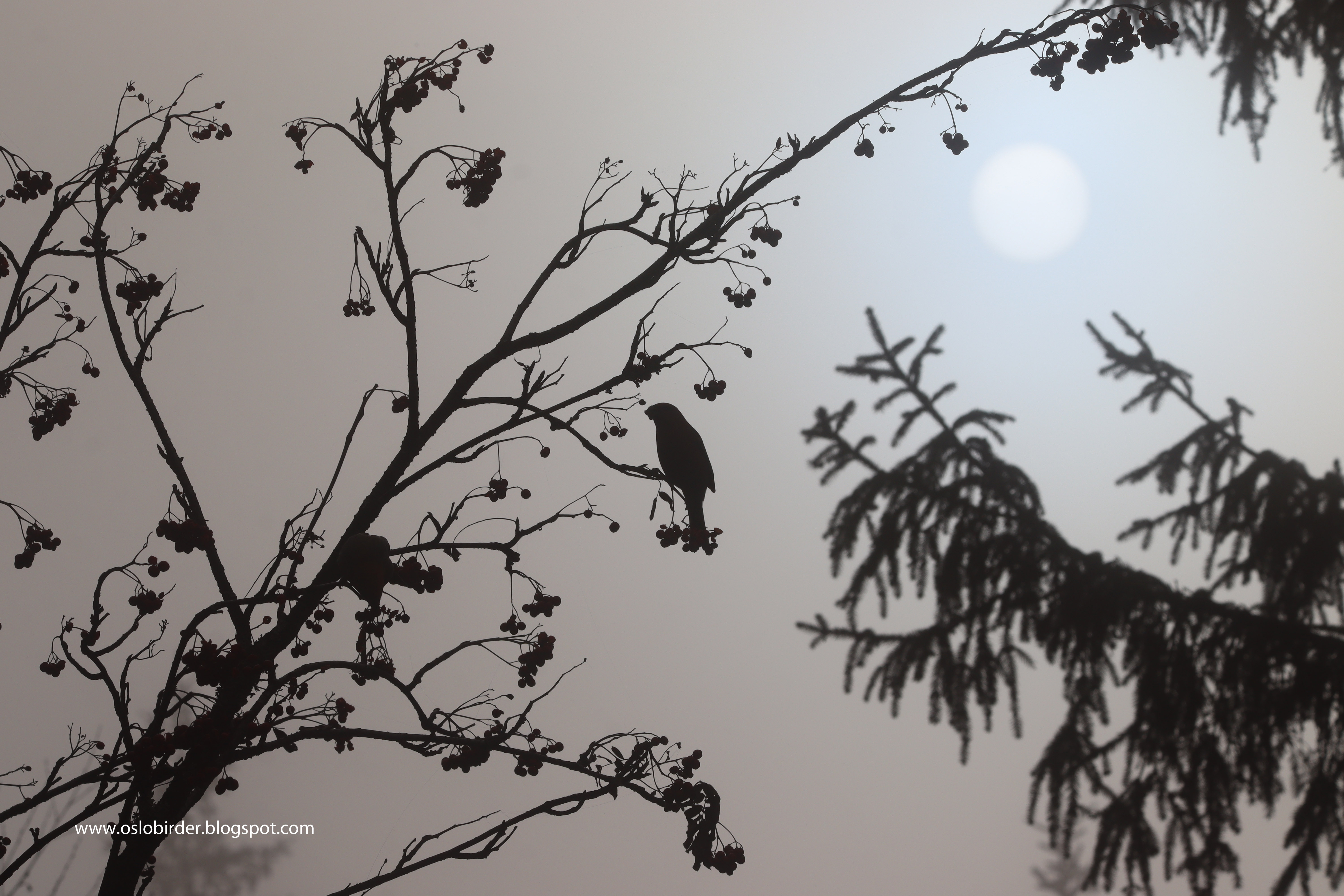
unfortunately when I encounter adult males it is foggy and dark
here the sun is just shining through the fog
this bird with a lot of red is I presume an advanced 1cy male but could perhaps be a 2cy male
although all the preceding pictures are of birds feeding on rowan seeds they spend equally as much time high up in spruce trees feeding on buds
and also in this instance in a pine
it was pretty foggy at Tryvann when I found at least 35 birds. Here the 118 high telecom tower is just peeking out above the fog
there have been some other birds. Here a Blue Tit (blåmeis)
here a size comparison of Blue Tit and Pine Grosbeak
Waxwings (sidensvans)
and a Mistle Thrush (duetrost)
this Meadow Pipit (heipiplerke) flew up from the ground in Maridalen without ever making a noise which makes it a scary pipit. I don't think its hind claws look particularly long but cannot make it into anything else