Jr and I have fled the heatwave Oslo is experiencing and have left temperatures in the mid thirties and replaced them with the low tens. This has resulted in two days and 1300km of driving to our cabin near Bodø. The weather should improve whilst we are here but I am writing this sitting next to a radiator on full…
As usual I kept a count of raptors on the drive up and it was a meagre total with just 3 Kestrels, 2 Peregrines, 1 Merlin, 1 Rough-legged Buzzard and 2 White-tailed Eagles meaning about 1 raptor per 150km….
Three well planned Beast walking stops did result in some action for me. A stop in 30C heat gave me an Apollo butterfly which even briefly landed on my head although the battery on my camera proved to be flat so I had to resort to photos with my phone. In this photo you can see me taking a photo of the Apollo.
Jr is the shade whilst I am enjoying this Apollo:
Just before we got to the Arctic Circle a stop in Mo i Rana gave me to two additions to my Nordland county list - Jackdaw (kaie) and Nutcracker (nøttekråke). I have tried for them here before with no joy but finally succeeded. Both seem to have an isolated northerly breeding outpost here and the Nutcrackers are of the siberian subspecies so are different to the birds around Oslo.
Adult and juvenile Nutcracker (nøttekråke) of the race macrorhynchos
Here the parent has extracted a seed from a cone to give to junior
A stop at Saltfjellet on the Arctic Circle was very successful with Long-tailed Skua and Red-necked Phalarope. The skua was actively hunting at very close range but I am unsure as to what it was searching for as a lack of any raptors suggests no rodents.
Long-tailed Skua (fjelljo)
Red-necked Phalarope (svømmesnipe) male who by his behaviour must have had young nearby
The last week of January has been quite like the preceding
three, i.e uninspiring, with the exception of reacquainting myself with my Hazel
Grouse. We can now look forward to February with hopefully some cloudless,
freezing cold, nocturnal trips interrupted only by the sound of trees cracking
in the cold, owls of various sightings hooting and northern lights flickering
overhead. By the end of the month the very first spring migrants will also with
luck have arrived and then we can really look forward to the spring and all the
bounties it brings.
I have had a few walks in the forest but it is incredibly
quiet there with, other than the HG, hardly a bird to see or hear. There are
ZERO finches in the forest and even in more suburban areas with feeders there are
hardly any so a flock of 18 Hawfinches that I came across at Østensjøvannet one
day was quite a surprise.
A noisy Nutcracker (nøttekråke) was one of only a handfull of birds seen on my forest walks but it is always a good bird to see.
the Pygmy Owl (spurveugle) has become harder to see again and when it does give itself up it is usually high up as here with a Magpie (skjære)
Mallards (stokkand) at Østensjøvannet
where this female Teal (krikkand) is still hanging around
and where with some patience Water Rails (vannrike) can be seen
an unusually large flock of Hawfinch (kjernebiter)
Woodpeckers are not really making themselves known yet although I have heard a drumming Great Spotted and this female Black Woodpecker was making a lot of noise hacking away at a dead tree trunk
During the Bird Race on Saturday we had a strange black & white
duck. First seen asleep with Mallards we hoped it was a Shelduck which we
needed for our list but when it eventually showed more of itself it clearly
wasn’t. We dismissed it as a domestic duck type although when we saw it again
on Monday I began to think that a hybrid Mallard x Common Eider was more likely
and took some footage. There are not many people who share my interest in
hybrid ducks and I don’t think anyone else has spent any time on it (I also suspect
it has been around a while).
A hybrid between Mallard and Common Eider sounds an unlikely
combination and indeed it is with only one report of a possible female fromNorway (although I would say that bird is another hybrid combo) and just a few documented birds to find on the web although a male at
Seahouses, Northumberland is well known.
Based on my photos I feel confident the bird is indeed this
hybrid combo with body shape, head and bill shape matching other reported birds.
not a great photo but I am confident this is a male hybrid between Common Eider (ærfugl) and Mallard (stokkand). The jizz of the bird especially head shape and the rear end short wings are closer to Eider than Mallard and match photos on eBird. The bill pattern with a black nail also matches other birds as do the light grey tertials (visible in the video). Plumage varies greatly between hybrids but this birds plumage also looks good for a mix between the two species even though it does not match other birds. It would have been nice to document it in flight and also out of the water.
The Pallid Harrier we had was seen migrating past the
lighthouse, first flying NE and later migrating out to the SSW. It was scope
views only and wasn’t photographed but a hunting Hen Harrier was and this of
course led to some confusion and suspicion…. Two Bird Theories are always good
but as the Hen Harrier was seen again after the Pallid disappeared out to sea
then I think it was a Two Bird Fact 😇. I managed some photos
of the Hen.
Hen Harrier (myrhauk) - a 1st year male if I am not mistaken
Back home I have looked for the Taiga Beans a couple of
times. On Tuesday I found only 72 on a different field to previously (but again
one that has been used in previous years) but on Wednesday found none so
perhaps they have moved on already after only two weeks but if that is the case
then it will be 2-3 weeks earlier than normal.
I counted 72 Taiga Beans but despite the field looking flat they were difficult to count and birds could disappear so there may have been more but definitely not 129
Water levels in Svellet are still low with lots of mud and
shallow water and many thousands of ducks and geese. There were very few waders
today but two Marsh Harriers and a White-tailed Eagle may have been responsible
for that. A single juvenile Little Gull, 2 Arctic and 2 Common Terns were nice
but I always feel there should be far more terns here.
this male Kingfisher (isfugl) was a nice surprise along the Glomma River
this colour ringed Common Sandpiper (strandsnipe) would appear to have been ringed in Norway as the combination of yellow flag on left leg and red ring on right is a Norwegian thing. Finding out more details though is proving hard work though... We also saw a Greenshank with the same red and yellow ring combo but were unable to read the code
we came a bit late to the lunar eclipse and missed the blood moon
part of a flock of 19 Nutcrackers (nøttekråke) that headed out to sea
some also landed in the bushes by the lighthouse. I am unsure whether they were of the slender-billed siberian subspecies or the resident thicker billed subspecies that we have around Oslo
distant Red Kite b(rødglente) being pursued by Hooded Crows (kråke)
we had a few Stonechats (svartstrupe) and the species has bred at Lista this year.
One of the main birding events around Oslo is the gatherings of migrating waders and waterfowl in Nordre Øyeren especially at Årnestangen and Svellet. I have not given this much attention so far this autumn and have missed the best bits which are normally at the end of July when thunderstorms can bring down a vast selection of adult waders. Now in late August the species variety is significantly less and almost all birds are young birds. On Wednesday I joined up with Jules Bell for a trip to Årnestangen and Svellet and yesterday I visited Svellet and Merkja. The most numerous wader was Ruff with around 250 birds in total and more unusual birds were Black-tailed Godwit, Curlew Sand and Little and Temminck’s Stints.
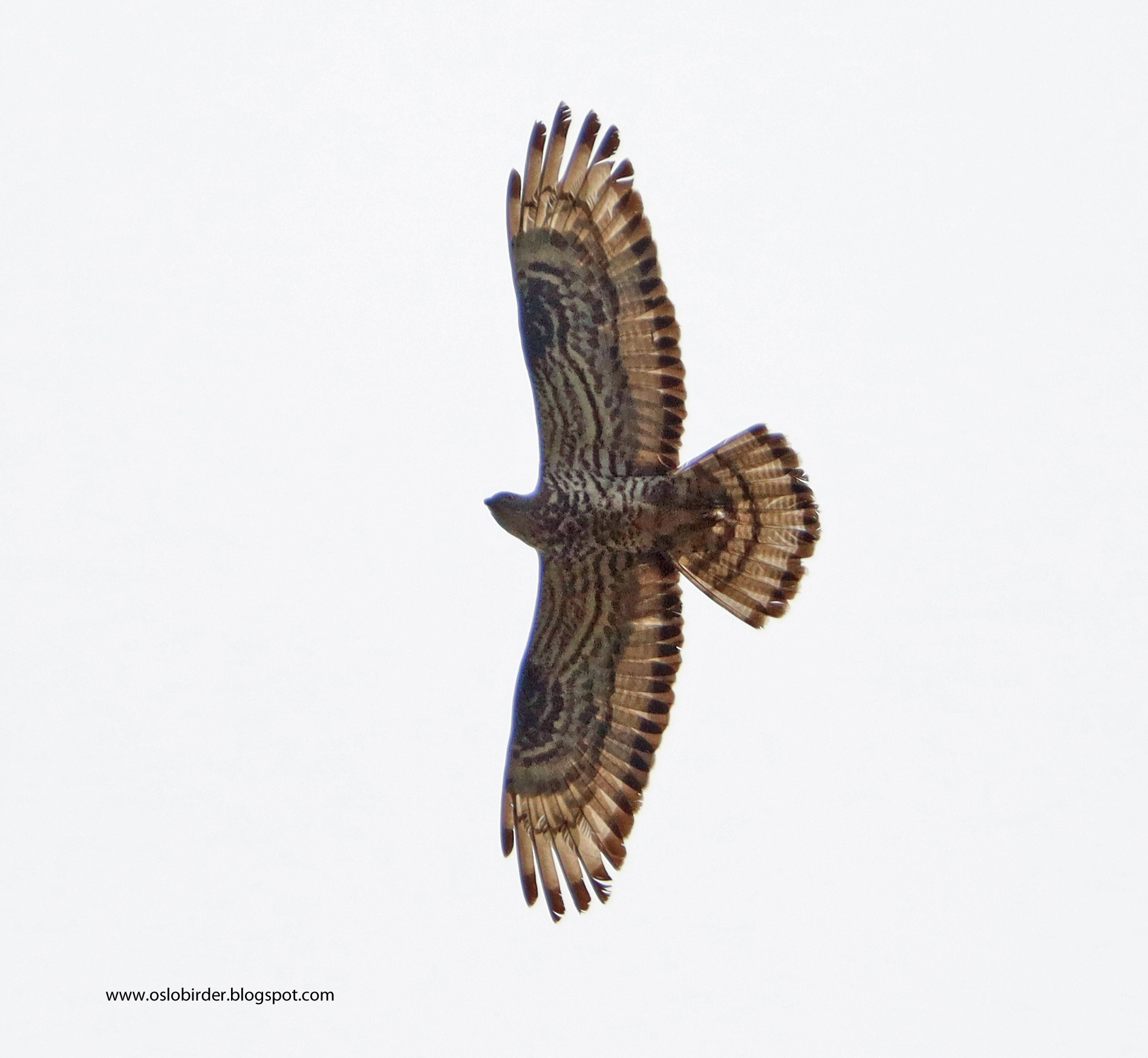
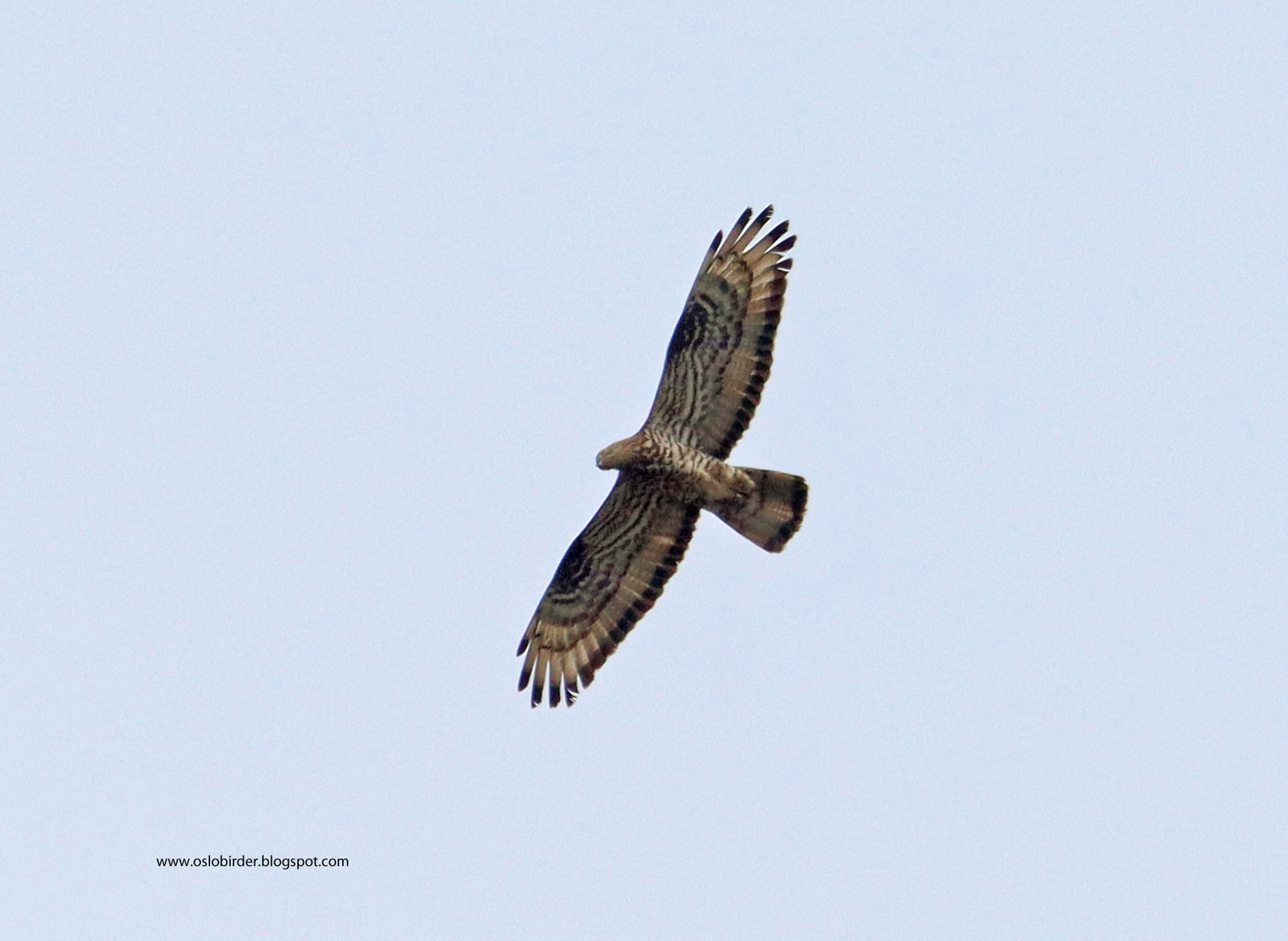
In Maridalen I have continued looking for raptors and especially Honey Buzzards but despite what I would describe as perfect condition there has been very little to see although the HBs will get their own post later. A young Peregrine has been a regular sight though terrorizing a group of Feral Pigeons that frequent one of the farms and amongst the few Common Buzzards is a particularly pale bird.
Svellet has been Made Great Again and alongside lots of Ruff (brushane) are a couple of Black-tailed Godwits (svarthalespove)
on the neighbouring Merkja two male Gadwall (snadderand) in eclipse
Goosander (laksand) in Maridalen. A female (middle) has managed to raise 8 young which is incredibly gowing considering that the many Goldeneye (kvinand) broods typically and quite quickly decline to one or two, or none
here male (who has had nothing to do with the family before now), a 1cy and mum
a 1cy Peregrine (vandrefalk) has been regular in Maridalen and likes to have a go at a small flock of Feral Pigeons (bydue) that hang around one of the farms
this pale Common Buzzard (musvåk) has also been a regular sighting
I have seen evidence of a Nutcracker in the garden with discarded leaves and nuts from our Hazel Trees on the lawn and today I saw the culprit from the kitchen window:
Here are photos of the more photogenic but sadly less rare
raptors from yesterday with a couple of pics from today. The Honey Buzzard sighting
was very interesting. I wrote that he was not near his nest (not that I knew
where the nest was) when he was calling but that looks not to be true. Upon
looking at my photos I see that when he flew over me he was carry a disc of
wasp cake but when he returned only 7 minutes later (which is when he started
calling) he was empty taloned. This surely means that he delivered the food to young
(in a nest) only 3 minutes flight away and he was not flying fast either. Neither
was he flying towards dense forest and although he disappeared for me due to a
line of trees I think the nest must be in one of a couple of low lying woods.
Today the same male appeared from the same direction (although quite high up)
but dedicated watching revealed no other sightings or clues as to where the
nest is.
Two male Goshawks were also interacting yesterday – one looks
to be an adult male and the other a 3cy male which is perhaps trying to muscle
in on a territory.
An adult and juv Hobby were also interacting with each other
and a Sparrowhawk high over the lake and it is unknown whether these were from
the local family or from further away.
male Honey Buzzard (vepsevåk) with a disc of wasp comb in its talons
and 7 minutes later without
here he is straining his neck as he had an Osprey, a Common Buzzard and perhaps most important a Goshawk to be aware of
his beak is open and he was calling
performing contortions
the same bird today. In the field in challenging light I thought this was a female but it can be seen to be the same male
Common Buzzard (musvåk) - a moulting adult
Sparrowhawk (spurvehauk) - there are a number of juvenile birds around that have fun practicing their hunting skills of anything no matter size
another bird
a male Goshawk (hønsehauk) with a Wood Pigeon (ringdue). This bird has a mix of old and new feathers and is a 3cy
this is probably the same bird but taken today, whereas other picture was taken yesterday
2 male Goshawks together yesterday
the closer bird is the presumed 3cy whereas the bird on the left is an adult. Note how it has the white undertail covert feathers puffed out which normally happens during display
adult above
Osprey (fiskeørn) - adult male
juvenile Hobby (lerkefalk) left sparring with one of its parents
the same juvenile, aged by the absence of red trousers
and here the youngster is sparing with a young Sparrowhawk
adult Hobby with its red trousers
Nutcrackers (nøttekråke) are regularly to be seen flying high overhead with their crops full of nuts. They fly many, many kilometres from the city into the forest where they store the nuts for winter consumptions
the fields are rather disappointing but there a few Yellow Wagtails (gulerle)