I may have had to leave Oslo but Easter did eventually
deliver the always hoped for good birding of the spring festive season.
There was also some luck involved. I am sleeping poorly at
the moment which often results in me leaving the house for a quick early trip
to Maridalen. On Monday though I awoke at 02:50 and feeling rather perky I
decided to get up and put in action a plan I had been hatching: head north to
Hedmark to find some Great Grey Owl nest sites, twitch a returning
Yellow-legged Gull in Hamar and see anything else that might turn up.
The drive went quickly and when I had my first stop at 5am
the skies were lightening up and as I got out of the car to scan some recently
felled forest there was a cacophany of noise from thrushes but also clearly
larger birds. The Black Grouse were not to mistake but I was at a bit of a loss
as to another bird. It reminded me a bit of Red-throated Diver but the noise
was coming from a pine tree… I could just make out a large bird and it was a
female Capercaille and another was calling close by. This is the peak time for
leks so I was not sure why they were not at a lek but maybe they have already
mated. Another noise also caught my attention and I had a feeling I knew what
it might be. I walked towards the noise and saw what was clearly a raptor nest
in a large pine and there was a big heading sticking up from it - I had found
Great Grey Owls in a natural nest! What was even better was the terrain meant I
could look down on to the nest - I had struck gold. The female was clearly
calling to let her mate know she was hungry and quite soon I was able to watch
him fly in with a vole for her which caused her to call lots. The male then
spotted and flew towards me to check me out😊
This is the first nest I have found completely on my own so
I was chuffed.
I enjoyed the owls for a bit and then drove on hoping to
find more owls hunting. That didn’t happen but I had three more female Capers
and I visited a platform I knew about and had a GG on it but it couldn’t beat
«my» nest.
Hamar and a dirty twitch followed and I saw the gull even if
I didn’t manage any photos but was just happy with the tick and couldn’t wait
to leave the town. The nearby delta at Åkersvika was a bit disappointing but a
nearby Rookery was a novel sight for me as this species it incredibly local in
Norway.
I had by now got news of a booming Bitteren and a singing
Black Redstart back Oslo way and although it was only 11am the day already felt
old. I decided that the Black Red would be enough for the day as it was
literally on the way home and was able to see it fairly quickly.
The Bittern only had to wait a day and successfully twitched
yesterday. It was at Hellesjøvannet where I heard the last of my only two other Norwegian
Bitterns back in 2013 but unlike then I actually saw the bird this time and
managed a fairly decent recording of the booms. Just like with GGO the very
deep «song» is very difficult to localise as it is almost louder the further
away it is and in addition it only sang every 20-30 minutes but eventually we
reckoned it had to be less than 100m from us in a stretch of reeds that were
less than 10m wide. I thought the thermal imager would make it easy to find but
it picked up nothing. I switched to continual scanning with the scope and after
a looong time it was finally there walking through the reeds. I took up my
camera but didn’t even know where to point it and returning to the scope it had
vanished again.
female Great Grey Owl (lappugle) on the nest before sunsrise
the male checking me out after it had delivered a vole to his mate
filming the nest after sunrise
enjoying? the sun. For a species that is built to survive freezing winters and hunt in snow I am surprised at how far south they have started breeding and they do not seem to keen on strong sunlight
the nest from below. I am not sure which raptor built it
this short video is taken with the superzoom and phone and you can hear the begging calls of the female. I need to edit videos I took with the bazooka which include the food delivery and will post later
the platform nest
the female Capercaille (storfugl) that I saw after having first heard it and not recognised the call
The call can be heard in this video after footage of another female I had along the road. At the end some distant Black Grouse (orrfugl) can also be heard
these two females were far more easy to observe. They had very different plumages with one being much paler and also having a large red skin area above the eye. I do not know if this is age related
this female was darker and lacked an obvious area of red skin above the eye
the paler female with a lot of red above the eye and also an almost male like "beard"
this one also puffed herself up in a way which I considered to be male like
the paler bird
male Black Redstart (svartrødstjert). The male that bred at the same site last year was a 2cy whereas this bird is a full adult. It is therefore reasonable to assume it is the same bird one year older
Hellesjøvannet on a cold (only +5) and wet (constant drizzle) day which maybe explains the infrequent booming from the Bittern (rørdrum) which chose to boom from the narrow belt of reeds in the middle rather than the more extensive reedbed to the right
The booming can be heard surprisingly well in this video which is much better than the video in my post from 2013 which I have linked to above. As it sang so infrequently I only managed to press the record button after it first started so it lacks the initial noises. The video has 4 different sequences.
a Rookery close to Hamar. The species is exceptionally local in Norway but it clearly has n problem being close to people. In addition to the rookery being right by houses the birds were also feeding in gardens
even if I didn't manage a picture of my first Norwegian Yellow-legged Gull (which is paired to a Lesser Black-backed) I did manage a photo of mating Lesser Black-backeds which are ignoring the plastic owl which is supposed to scare them off
the drizzle at Hellesjøvannet had caused a concentration of all three hirundines. Here a Sand Martin (sandsvale)
Sand Martin and Swallow (låvesvale)
it may be a pants photo but all three species are visible
I spent little time in Maridalen and this was the highlight - two female Pintail (stjertand). This is not an annual species and previously has always been pairs or single males so two females was something different
In the two days since my last post I have had three
new species for the year but I am still praying that we get some rain soon so
that we get a real fall of migrants. Yesterday I had my first House Martin
which was a really early date and the earliest ever in the Dale. Today was Barn
Swallow and Willow Warbler on a more expected but still early date. These two
species cannot fail to bring a BIG smile to lips and both were also not shy in
giving their classic spring sounds.
Today there was also a clear arrival of duck on the
lake with a flock of 34 Teal and 6 Tufted Ducks moving around quite nervously
as though they had better places to be. Now is the time of year to be checking
out Svellet and Nordre Øyeren but water levels there are extremely low ahead of
a feared spring flood (due to lots of snow in the mountains) and the birds are
a long way from land with lots of heat haze forming sandflats between you and
the birds. These very low water levels now though promise well for a couple of
weeks times when wader passage will be peaking.
Raptors have failed to show as I had hoped but
yesterday I enjoyed watching the local Buzzard pair eating frogs – they were
ripping off surprisingly large strips of bloody flesh from their amphibian
prey.
Butterflies are very noticeable this spring
especially Small Tortoiseshells which seem to have good winter survival.
Today I saw three Green Hairstreaks which is my seventh species for the year so
far, the others being Brimstone, Small Tortoiseshell, Comma, Peacock, Holly
Blue and Camberwell Beauty. I have also seen an unidentified white butterfly
which was probably Green-veined White.
my first Barn Swallow (låvesvale) of the year - its very long tail streamers leave little doubt that this bird is a male.
this flock of 6 migrant Tufted Duck (toppand) were quite nervous and often in flight. Behind them is one of 5 Black-throated Divers (storlom) on the lake today
my first Willow Warbler (løvsanger) of the year which was giving its beautiful song
this male Yellowhammer (gulspurv) was clearly not well. It had blood around its bill, kept closing its eyes and was shivering.
Green Hairstreaks (grønnstjertvinge) are really small and very difficult to find when perched on something green!
Maridalen's earliest ever House Martin (taksvale) deserves a picture no matter how bad it is
Before I come with the Great Snipe pictures and
videos (my best ever I think) here is a post with the other highlights from the long weekend in the mountains. It is
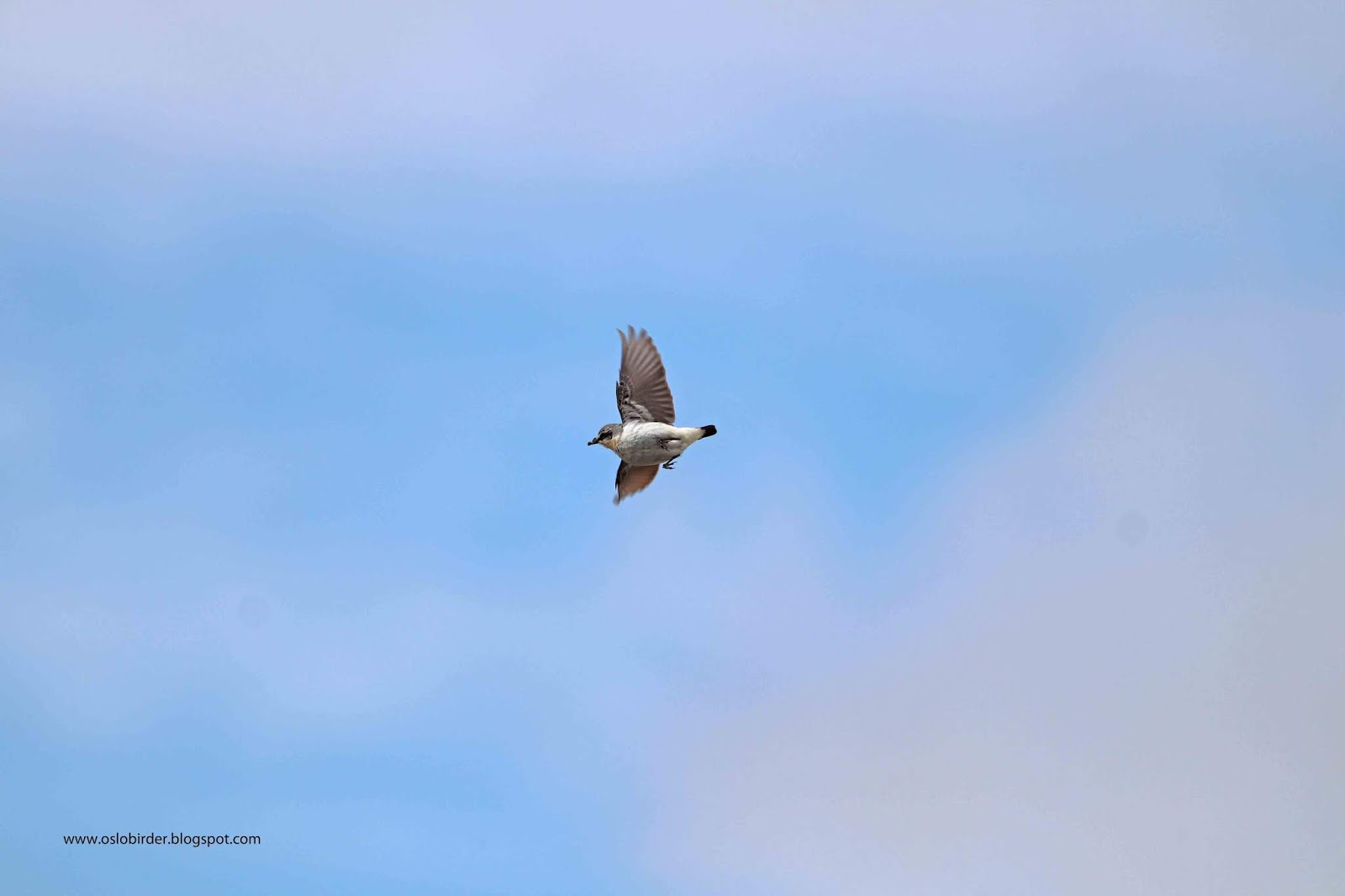
not just about scarce birds. Watching a male Wheatear who repeatedly hovered in
the air was fascinating. Why he did it I am not sure but he had a feather stuck
to his bill plus had the strangest song I have ever heard from the species so
was perhaps not quite himself. House Martins collecting mud for nests that were
under eaves only 2 metres above the ground was also fascinating. A male Snow
Bunting in full summer plumage was a very unusual sight for me and Long-tailed
Skua, Ptarmigan, Shore Lark and Temminck’s Stint are species one always hopes to see when one visits
the area.
House Martins (taksvale) collecting mud
this Kestrel (tårnfalk) was still hunting whilst we were watching the Great Snipe. This attempt at art is taken with a shutter speed of 1/40 second
Long-tailed Skua (fjelljo) in the mist. A few seconds later and it vanished
Mogop / spring pasque flower / arctic violet / lady of the snows / Pulsatilla vernalis is a common flower in the area
my only Ptarmigan of the trip
Ringed Plovers breed by the sea in Oslo and also at over 1400m
scarce ducks waiting for their breeding lakes to be ice free - 3 Long-tailed Ducks, 2 Scaup and a commoner Tufted Duck
the Shore Larks (fjellerke) were NOT photogenic
surprise of the trip a singing Skylark (sanglerke) at 1400m on the tundra
male Snow Bunting (snøspurv)
Temminck's Stint which always seems to only occur right by the road
fresh snow fell on these mountains which are over 2000m high
Woodcock (rugde) roded over the Great Snipe lek
male Wheatear (steinskvett)
he persistently hovered although why I am not sure of