Well, it seems birding still has something to offer so
butterflies can wait just a bit longer which is just as well given the wet and
cloudy weather we are forecast to have.
Just after I wrote my last post an evening trip to Fornebu
allowed me to first hear and then see a Gropper that had been found earlier in
the day. Grasshopper Warbler remains a very scarce and not even annual special around
Oslo and was unsurprisingly the first record of the year. This is the second
time I’ve heard one at Fornebu with the first being a bird that arrived at the
end of April in 2019 and hung around for a month. An April arrival fits in with
the small regular Norwegian breeding population that are mostly found on the
west coast whereas an arrival at the end of May/beginning of June (that is the
normal fare in south east Norway) which often occur during warm periods with
southerly winds may well be a bird that has already tried its luck somewhere
else in Europe and has then decided to move north looking for more joy.
Grasshopper Warbler (gresshoppesanger) Fornebu
Last night I was about to go to bed but then looked at the
weather forecast and realised that even though conditions were not perfect (it
was cloudy and damp) it would be quite a few days before there were any better
conditions for some night singer activity. Maridalen started very quiet with
just two Woodcocks for my troubles as I got to the end of the valley. A distant
Tawny Owl had me trying to drive closer to locate it as amazingly enough this
was only my second record this year. Early spring nocturnal sorties had
resulted in just one very distant singing Tawny Owl which must have been a sign
of how little food there was. Vole numbers may be picking up though as in
addition to the two Tawnies I now heard a GGO was photographed in the forest just east of Maridalen last week. Maybe Oslo will have an owly autumn and
winter?
As I drove with the window open I heard a noise that I
thought was from the car but after turning off the engine (an electric car
would be very good on these trips) I realised I was listening to my second
Gropper in two days and only my fourth ever in Maridalen - and boy did it sing!
I was able to see it quite well using my head torch and whilst doing so I
thought I heard a Nightjar call. A bit later it called right over me and I then
got to see it really well as it hunted moths around me and even sang briefly
from a fence post.
I set about trying to record this unforgettable experience….
but as usual my phone has far fewer videos than I thought I took plus a good
number of videos of the ground…. I thought I was seeing a
red light showing I was filming but surprise, surprise things were not as I
thought. I wonder if there is a support group for people like me? I also had
the superzoom with me but despite use of the head torch it really struggles in
the dark. I did get some documentation though:
First a video of the Grasshopper Warbler with a bonus Sedge Warbler at the end:
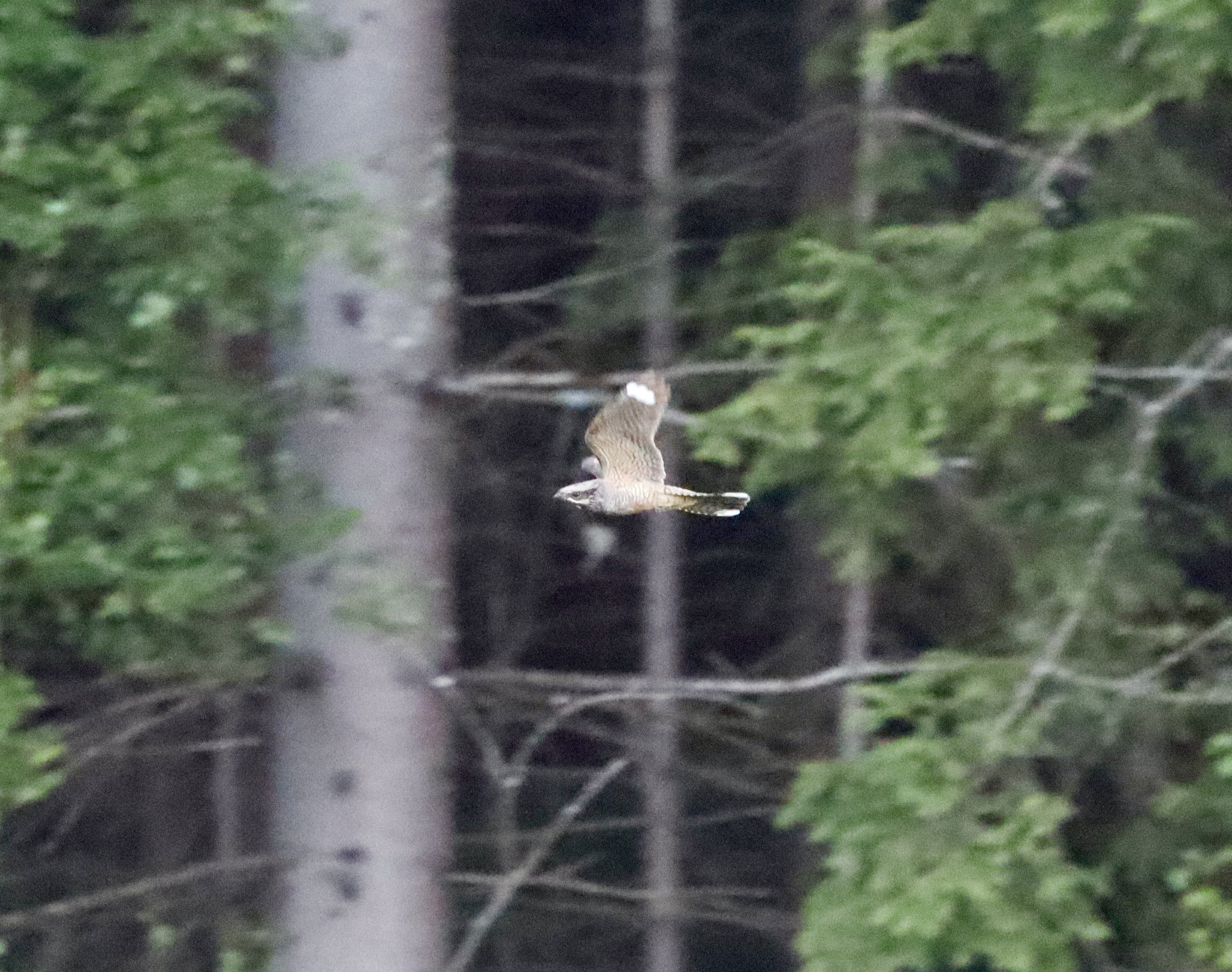
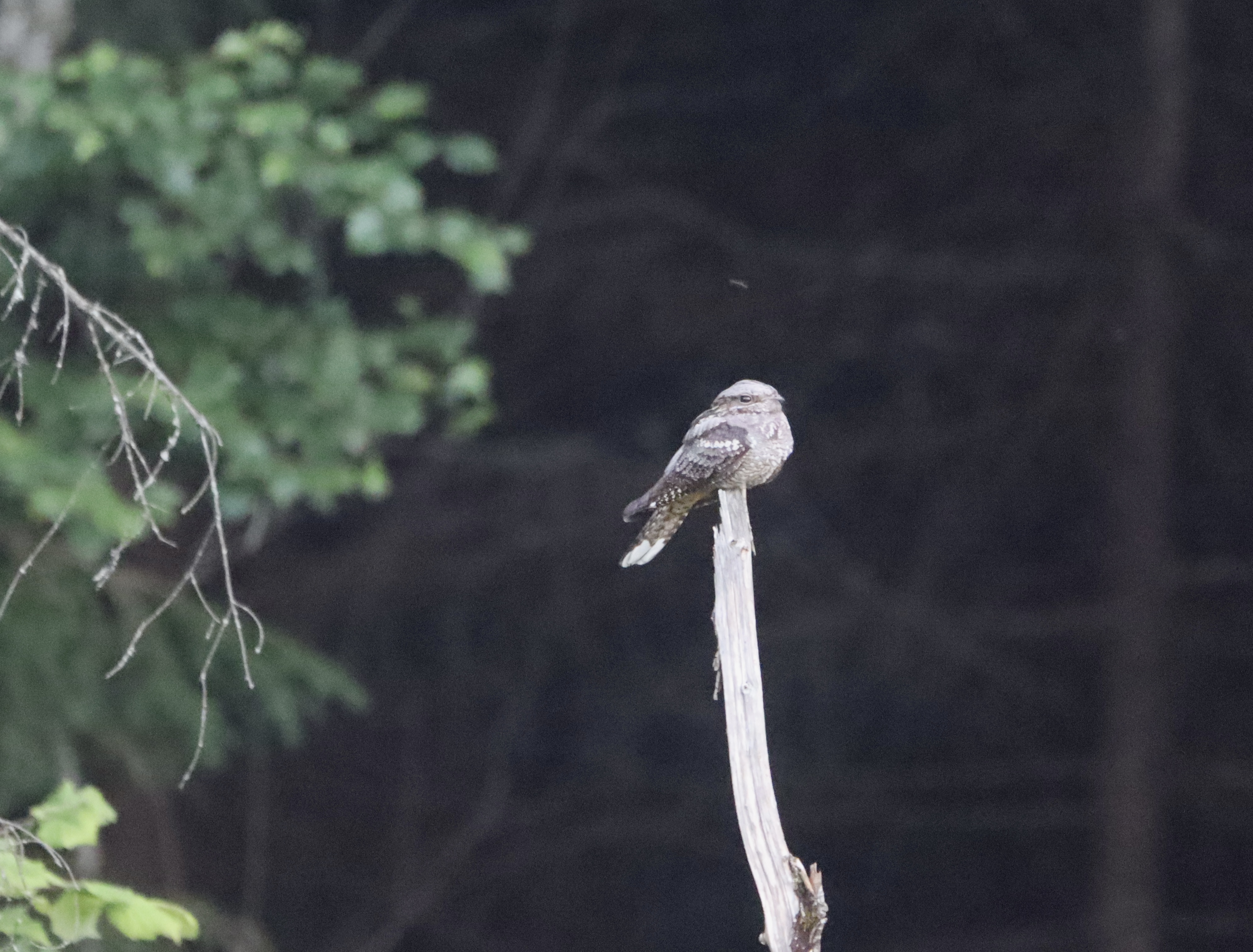
Pictures of the Nightjar
Nightjar (nattravn)
here we can see the white wing patch showing it to be a male (as confirmed by it singing)
And video of the Nightjar which does have a sequence of it moth catching from a fence post and then briefly singing with the sound of the Gropper all the time in the background:
On the way out a Sedge Warbler was in full song and this was
a Maridalen tick for me🥳. I had first heard it
in the middle of the day but only a couple of snatches of song which were not
enough to confirm the ID. The ID was later confirmed though by Jon Andrea, an
up and coming teenage birder who gives me hope that birding in Oslo has a bright
future and by the evening it was not holding back.
There are now two Barnacle x Canada hybrids in Maridalen and
both are different to last week’s bird so we really are talking about an
influx.
both of the Canada x Barnacle (hvitkinngås) Geese hybrids
paler bird with a white forehead and hardly any hint of a darker chest
the darker bird
this bird is I am sure the paler bird but due to its posture it is showing off a white neck collar which doesn't show in the other photo
the darker bird really stands out
here the darker bird, a Canada with too much white on the head and a Canada x Greylag hybrid
I went looking today for a retrospectively identified (heard
only) singing Red-breasted Flycatcher found last week and which is the first
record in Oslo since the last bird in Maridalen in 2019. The area where I believe
it was heard looked just like the areas where they have previously been found
breeding in Oslo but I heard nothing which either means it has moved on, or he
is mated up and breeding as in my experience they go silent as soon as that
happens and only start singing again once the eggs have hatched. The area was coincidentally
one I have frequently visited for butterflies especially Northern Chequered Skipper
and a brief period of sunshine did wonders and in addition to the skipper I
also had a couple of Wood Whites which is a species I have seen even less often
than the skipper.
here showing the underside of the wing and with a Green-veined White (rapssommerfugl)
and here with a Brimstone (sitronsommerfugl)
At Fornebu it was also great to find a Ringed Plover family. The species only regularly breeds around Oslo only on Gressholmen and at Fornebu. A couple of pairs have tried breeding at Gressholmen this year but seem to have failed despite two attempts whilst at Fornebu the available habitat is getting smaller and smaller. Finding this adult with two young about a week old was therefore heart warming. They were close to a road and two young have also most likely been lost (they lay 4 eggs) and the odds are against these two but fingers crossed that they make it.
here the adult is sheltering one young whilst another runs away. I was watching from the car.
this is the one that was being sheltered. Note that the legs of the young look already to be fully grown
The Nightjar pair I mentioned in my previous post were not to be seen at the same site again although I did have a pair nearby and believe they were moving around and prospecting for a nest site although it is rather late in the season now. Nightjars proved to be rather common in the area with at least 4 territories along a 1.5km stretch which is in start contrast to up until 5 years ago when I had none on my nocturnal trips from the cabin and it is only 2 years ago that I first recorded a bird along this particular stretch. This is a species which along with Great Grey Owl seems to directly benefit for the surge in forestry work this last decade or so.
I have engaged in some sea gazing whilst having my morning coffee and usually saw nothing but yesterday two Sandwich Terns went south - this will presumably now become a species I bump into «all» the time after having waited 24 years for my first in Norway - and today a Caspian Tern went north😊. Apart from these three quality terns I only had 3 Common Terns in total during the week so definitely a case of quality over quantity.
Sea gazing from the cabin is a very comfortable affair but the area of sea that can be viewed is very narrow however I am building up a good list of birds now with these two scarce terns adding to Pomarine Skua, White-billed Diver and Surf Scoter.
Butterflies have again taken up more time than birds although I have also read a book and gone for walks and spent time with my family☺️. After a couple of days with rain it was sunny on Wednesday and it was noticeable that new species were emerging for the first time with especially Ringlet (gullringvinge) appearing in the area for the first time this trip and being numerous overnight.
Sea gazing with coffee, OJ, The Beast and a minute before 2 Sandwich Terns (splitterne) which I did not manage any photos of.
The Caspian Tern (rovterne) did however allow itself to be recorded for prosperity
A Linnet (tornirisk) flying out of this conifer by the cabin had me suspecting a nest
And sure enough there was one. The parents were very secretive when visiting the nest although the male would be perched nearby singing when the female entered with food
Summer holidays have begun and per tradition our first week is at a cabin south of Oslo near Hulvik. Butterflies are in short supply so far except for Queen of Spain Fritillaries (sølvkåpe) which are by far the most numerous species and in numbers I have never seen before.
Evening drives with Jr have become another tradition and our first one gave a good haul with 4 Moose including a mother and tiny calf, 3 Roe Deer, 2 Badgers and 3 unidentified small bats. I started with animals as that is Jr’s priority but on the bird front we had 2 Corncrake, 2 Quail, 5 Nightjar, 3 Tawny Owls, 2 Long-eared Owls, 3 Marsh Warblers and quite a few Woodcocks.
The best experience came as we were nearly back at the cabin when we found a pair of Nightjar seemingly nesting. It was as dark as it gets by then but I will spend more time with them and hopefully with the use of the thermal imager get an insight into their secretive lives.
Red-backed Shrikes are scare this year with just 2 males seen one of which was singing so unpaired but the other probably had a female on the nest.
This is the only picture I took of a Nightjar (nattravn) with the superzoom at 00:10. I should probably have taken some more but was concentrating on video
Before I bore most of you with a butterfly post it is about
time with another catch up of local Oslo birding.
Hobbies are back in Maridalen and have clearly chosen a new
but yet to be discovered nest. I have seen a single Honey Buzzard over
Maridalen and the nest of the last two years has had green branches added to it
although no birds are on the nest yet.
The last Lapwing nest in Maridalen is now empty and I think
that the young have hatched due to the behaviour of the parents but the crop is
now too high to see. One evening whilst the nest was still occupied a fox with Lapwing
young on its mind walked through the field. I have a long video of the event
and the adults were very effective at attacking the fox and also calling their
young away.
The four Little Ringed Plover eggs have hatched and the
parents are doing a great job keeping them alive. They deserve a separate post
though as there is a lot to see with them.
Nocturnal singers are slowly increasing with at least 4
Marsh Warblers in Maridalen and a Nightjar in an unexpected location that
showed very well.
Arctic Terns remain on the lake including the 3cy bird with
the missing tail feather and it is fun watching them on every visit to the
lake.
A video of the Nightjar (nattravn) to start with
adult Lapwings (vipe)trying to chase off a fox whose back is just visible amongst the buttercups
j
this young Lapwing is nearly fully grown and was flapping its wings
my only Oslo Honey Buzzard (vepsevåk) so far this year
this pair with the male on the left were in Østfold
the Honey Buzzard nest from the last two years with fresh spruce branches added
Arctic Tern (rødnebbterne) with a mayfly in its sights
and about to be caught
Hobby (lerkefalk)
spot the Red-backed Shrike (tornskate). There has still not been any major arrival and I have not located any breeding pairs yes
A Blue Tit (blåmeis) nest jut above ground level
when a Chiffchaff (gransanger) flew up from by my feet I knew there must be a nest nearby and here it was
The first week of school summer holdiays is, as always, being spent at the cabin we are so lucky to be able to use near Hulvik. No seawatching to mention and few birds although the now to be expected close encounters with Nightjars were as good as ever.
Nightjar (nattravn). Definitely one of my better efforts and taken before sunset although we were in shade at 22:34
It is bugs that are my main interest here and a 30 minute drive brought me a new dragonfly species with a single male Club-tailed Dragonfly (klubbeelvelibelle) showing along a muddy slow moving river (a habitat that is very unusual in Norway).
My first club-tailed Dragonfly (klubbeelvelibelle)
I also added a new species of butterfly to my list but didn’t realise at the time and that despite it being one of the largest and most spectacular species there is. I was walking my usual butterfly route here and only 50 meters from the car saw what I thought was a Poplar Admiral (ospesommerfugl). I can still count my encounters with this species on one hand so quickly raised my camera only to find the battery was flat. I went to my pocket for my mobile only to realise I’d left it in the car…. I jogged back to the car to remember that I had not bought the bag with a spare battery but I did have the superzoom in the car (where it always resides). Taking this (and my phone) and jogging back - who would have thought butterfly watching would be good exercise - I found the butterfly again a bit further along the path where it was sucking up some sort of sustenance. I was most interest in taking video of it but did note some markings that I didn’t remember from before and was also a bit puzzled by how blue the upperwing looked at some angles… It was only when I got home though that I looked at some images and realised I had in fact been watching a Purple Emporer (stor purpurkåpe). This is a species that was first seen in Norway as recently as 2019 and which has been recorded under 50 times since.
A bit embarassing that I did not recognise it there and then and I realise now that I thought it was a much larger species than it actually is.
Purple Emperor (stor purpurkåpe)
Look at that blue colour
And then a slight change of angle and it just looks black
This is one of those posts done on my iphone blog posts that I am sure will come out looking rather strange with different font sizes but with luck I’ll post something better later once I’m home.
A lot has happened since my last post. Firstly, the weather
forecast for Friday became mouth wateringly good with rain starting at dawn and
continuing through the day and I was now thinking I was going to decamp to
Gressholmen and experience an Oslo wader fest the likes of which haven’t even
been dreamed of. But then the next time I looked the forecast had changed to
only a slight chance of rain so we will have to wait and see.
Secondly, and most importantly, I spur of the moment decided
to listen for any nocturnal activity in Maridalen yesterday and was royally
rewarded with not one but two Nightjars, Oslo #174. This was a new Dale species
for me, #208, and comes after the first record last year which seemed to only
be a one night bird and which I could not find the following night. With all
the forestry work over the last few years which has created far more open
forest and clearings it felt like only a matter of time before the species
colonised. I heard a very distant bird at 23:10 and couldn’t work out exactly
where it was and attempts to get closer did not reveal it again. But at 23:50
in a different area I had another bird which churred and flew over me and even
allowed itself to be photographed 😊
Unfortunately, as I was not expecting this encounter I did
not have the camera settings right but hopefully I will be offered another
chance and will be better prepared. Other than the Jars I could only muster up
3 Woodcock. It is still very early in the season but a good showing of night
singers in Oslo will be vital if I am to break my record.
Nightjar (nattravn). Not too shabby a picture for 23:56 and handheld using a headtorch