Day 4 was weather wise pretty much perfect for being in the field and far better than the forecast. Often there was no wind at all and you could hear the noise of a warbler’s bill snapping at an insect. There were only a few indications of new arrivals and it was not a big day by any stretch of the imagination but it was a good day to be out and about and 16,000 steps were pounded.
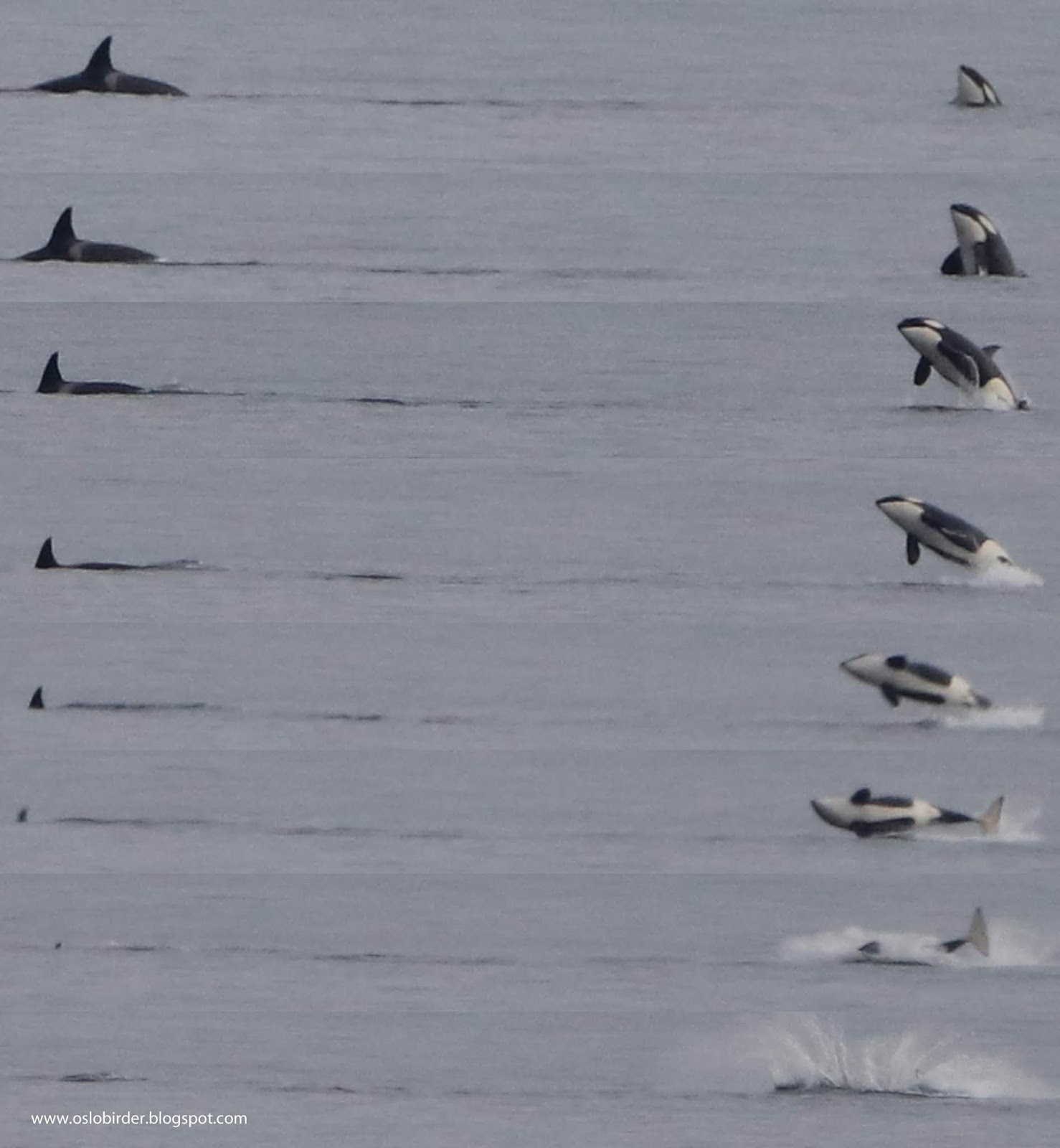
Experience of the day was a pod of Killer Whales powering through the sea off the north of the island early morning.
Bird of the day was a Common Rosefinch (only my third on Værøy and a species that is close to but not annual out here).
Learning of the day was that I cannot tell Olive-backed and Tree Pipits apart on call. These two species were traditionally considered inseparable on call but in the last 10-20 years it has been accepted that with experience you can tell apart. Based on my experiences and observations on Værøy I also thought I could but today that confidence came crashing down. I heard a pipit calling in flight and immediately identified it as an OBP. I had my phone ready to play the call and straightaway the pipit appeared above me calling and the call was as far as I was concerned the same as I was playing. It landed on the fish drying racks just a few metres away and I immediately set about taking pictures. Head on it did indeed look like an OBP with a black spot on the cheek but as it turned sideways on to me I thought the wing bars looked far too white and I wasn’t seeing any green tones. Then when it turned away and I saw the well streaked back I realised without doubt it was a Tree Pipit. This whole experience made me immediately realise my OBP record from yesterday had to be pulled and also had me wondering how I could have got it so wrong.
OBP in late autumn outnumbers TP on Værøy by around 10 to 1 and therefore identifying a bird as OBP based on call and then confirming it by seeing it is statistically very likely to happen. Had I (we) just been playing the numbers? I don’t know the answer to that but a Tree Pipit in October is rarer than an Olive-backed so I should perhaps be happy with my observation.
Other quality birds were a single YbW, Jack Snipe, Bullfinch, a tristis Chiffchaff, proper Barnacles Geese from Svalbard (rather than the feral birds around Oslo) and a Short-eared Owl and quantity was provided with hundreds of Redwings and Redpolls.
The view at 0715 - it all looked very promising
Sunrise at 07:29
Migrating Barnacle Geese (hvitkinngås)
Looking north at 08:08 with the island of Mosken and behind it the Lofoten island chain
Killer Whale
Not an Olive-backed (sibirpip) but a Tree Pipit (trepiplerke)
Jack Snipe (kvartbekkasin)
Common Rosefinch (rosenfink)
The wood (skogen) suffered in a storm a few years ago and all the trees in the middle have now disappeared leaving just a ring of trees. The Rosefinch was in the too of the tall Rowans to the right
Very Grosbeak like
A Common Snipe (enkeltbekkasin) doing an impression of a Jack by freezing at close range
Here are the photos from
the last day on Værøy. It took a long time to go through them as I had taken
over 600 plus some video. As always it is a joy just going through the pictures
and remembering the creatures depicted. Hope they will be just as enjoyable for
the readers of this blog although I suspect I will publish far too many…
My third sighting of Olive-backed Pipit (sibirpiplerke) and finally a self-found bird without ring and which allowed good photo
with the island of Mosken and the Lofotens in the background
together with a Meadow Pipit (heipiplerke)
which then annoyed the OBP
Gyr Falcon (jaktfalk) - despite the range and poor photo this is my best views of this species
Rock Pipit (skjærpiplerke) in a tree
Twites (bergirisk) were very numerous this year
Killer Whalte (spekkhogger)
a mother and youngster
the dorsal fin on the bull was so large that it was floppy
one of the younger animals was playful
here the whale is at around 2km range and the snow capped mountains are in the Bodø area and are around 75km away!!
clear tracks from an Otter with the tail having left its mark
among the Otter tracks were also these smaller tracks which must be from Brown Rat that I guess had follwed after the Otter in the hope of find a fish carcass and some food
this Small Copper (ildgullvinge) is the latest record in Nordland county by a few weeks
Small Tortoiseshell (neslesommerfugl) and Painted Ladies (tistelsommerfugl)
Here are a selection of photos from around Bodø and Værøy.
11:55pm looking north from Værøy- the sun shines strongly
midnight. The sun sets (real midnight sun is restricted to a few days at the end of June at this latitude)
First some of the different Lesser Black-backed Gulls
(sildemåke). First off, the fuscus from
Valnes, notice the dark wings without any real border to the black wing tips.
presumed fuscus Lesser Black-backed Gull
presumed fuscus Lesser Black-backed Gull - notice how the light can change the appearance of the upperparts
Some from Værøy:
A fairly easy graellsii
An obvious graellsii
in the middle with a Herring Gull (gråmåke) on the right and a darker LBBG on
the left which I take to be an intermedius.
A difficult bird which could be dark graellsii or pale intermedius.
Another difficult bird which was quite small and cute so
probably a female. The flight shot shows significant contract between the wing
and wing tips so this is a graellsii
I reckon. Also the photo was taken at 10pm so the grey back probably looked darker than it would have looked in the middle of the day.
I’ve read that the intermedius
types in northern Norway might be the result of hybridisation between fuscus and graellsii. I don’t know about this but I can say that LBBG’s come
in the whole range of colours up here. I also saw one dark graellsii type seemingly paired with a Herring Gull which could
result in some even more difficult looking offspring. EDIT: of course I had not considered the possibility of HEUGLINI when I wrote the original entry. I don't believe there are proven records of this sub-species in Norway but it is probably just as likely at this latitude and longitude as Graellssi
Some other pictures:
Killer Whale (spekkhogger)
3 Killer Whales including a youngster
Otter
Common Seal
Also some scenic botanical shots from Værøy
A pale Whimbrel (småspove) – Slender-billed Curlew look
alike
A group of five young Pintails (stjertand)
1k Pintails - the green on the wing of the right-hand bird shows it to be a males