Monday, 24 April 2023

Winter returns

Since my last post the weather has changed from being summer like to a return to wintery conditions. Friday and Saturday remained hot with temperatures upto 18C and sun cream having to applied liberally whereas Sunday and today have been wet and cold with a bracing northerly wind blowing and snow once again falling on the hillsides around Maridalen. Neither of these weather types has resulted in any great new arrival of birds which was great for me as I was busy this weekend being a good (Norwegian) father and working at a second-hand market to raise money for Jr Jr’s out of school activities. I have to do this two weekends a year and both are in prime birding season so I fret every time I get a message on my phone and wonder what I will not get to see.

I did get to pop out to Maridalen early on Sunday morning in the rain and apart from lots of thrushes on the fields the only interest came from a Little Ringed Plover. After last year bumper success for this species due to the low water levels I was wondering whether we would have any records this year. The water level is too high for breeding but I was expecting some of last years birds to at least pop in just to check on conditions and I would like to think that the bird I saw was one of the last years birds.

Today was equally disappointing with hardly any duck on the couple of open areas (the lake is still 99% frozen) but a male Hen Harrier did make the day. It is quite interesting that of my observations of Hen Harriers (10+) in Maridalen the vast majority have been ringtails at long range migrating over whereas the two times I have seen an adult male it has been low over the fields. Today’s bird quickly flew over the lake so my views were brief but if the bird had been the long awaited Pallid Harrier then I am sure I would have described the views as fantastic 😉

On Friday I visited Svellet again and the water levels continue to rise such that it looks like the wader season will be over before it begins which is a crying shame but it seems the hot weather caused the flood to come early. There is still lots of snow in the mountains though and we can hope that the water level will be lowered though such that it can receive this later flood and hopefully that will happen in 2 weeks time.

male Hen Harrier (myrhauk) in Maridalen

male White Wagtail (linerle)

Little Ringed Plover (dverglo)

a pair of Mute Swans (knoppsvane) has turned up again in Maridalen and if they try to nest then we are guaranteed lots of action with the Whooper Swans unlikely to accept their presence

one of two Pink-footed Geese (kortnebgås) in Maridalen


Smew (lappfiskand) at Merkja on Friday


Thursday, 20 April 2023

Raptors

This week has been sunny and hot with north east winds and is just the type of weather that means there are very few arrivals of new migrants (and is also typical weather for mid April which is often a bit of quite time for birds). It makes me think that raptors are the most likely excitement and I have spent a lot of time positioned at what I think are good watch points waiting for that Red Kite or Pallid Harrier to come past which of course they haven’t. It seems that my strategy of sky gazing has been wrong and I should just have gone for a walk with the Beast as it seems that almost everyone with a camera and their dog has stumbled upon Red Kites recently.

I have seen quite a few raptor, 11 species in fact, which sounds quite good but in terms of raptor per hour watched it was a dismal statistic. Very few of the birds I saw seemed to be birds on active migration – only  singles of Hen Harrier, Rough-legged Buzzard and Merlin plus a few Sparrowhawks, whereas many of the other species were seen displaying and were clearly local breeders – Marsh Harrier, Kestrel, Common Buzzard, Sparrowhawk and Goshawk. Osprey and an adult White-tailed Eagle were also probably local breeders but just passing by. Marsh Harriers were particularly numerous and I saw nest building and sky dancing from multiple birds. This is a species that is increasing year by year in Norway and will soon be one of the commonest raptors in south eastern Norway.

males Kestrel (tårnfalk)


a sky dancing female Marsh Harrier (sivhauk)

same bird

Osprey (fiskeørn)

Rough-legged Buzzard (fjellvåk)

a ringtail Hen Harrier (myrhauk)

the HH bottom left with a Marsh Harrier top right

male Marsh Harrier

Common Buzzard (musvåk)


Crane (trane)


Black-throated Divers (storlom) in Maridalen

and a female Smew (lappfiskand) with Teal (krikkand) at Merkja

Monday, 17 April 2023

44 Cranes in the Dale

On Saturday night I took a trip into Maridalen with my thermal imager hoping to find hunting owls of the eared kind. My optimism was based on the fact that Kestrels have been hanging around and as the snow has melted I have seen lots of tunnels in the grass left by voles. I therefore concluded that these areas which attracted vole eating BOPS by day may also attract the night eating varieties. Well, I found no owls but both Woodcock and Common Snipe were on the fields probing away and there was also activity from both Teal and Mallard which seem to just loaf around on the edge of the ice during the day but clearly fly out to the fields to feed at night.

On the ice I could see that a group of large birds was roosting but the distance was such that I could not ascertain what they were except for that they were very large. Their identity became clear the next morning though when an enormous flock of 44 Cranes were feeding on the field at Skjerven. This smashes previous counts and they stayed the whole day and were marvelled at by many. At the other end of the size spectrum a Lapland Bunting played hide and seek in the stubble fields.

Today felt like the first day with temperatures rising to +15C (wasn’t it just a month ago when they were -15C?) and I thought this might result in a bonanza of migrating raptors. That was not the case but I did see my first Rough-legged Buzzard of the year flying high over towards the west. Perhaps not surprising given the sunshine and heat was an emergence of butterflies with 5 different species showing themselves off (probably the complete haul of species that over winter as adults)  Small Tortoiseshell, Peacock, Brimstone, Comma and Camberwell Beauty.

Cranes (trane) in Maridalen - part of a flock of 44. The farmer failed to harvest a small area of the field last autumn and this had been very popular with Whooper Swans, geese, Mallard and now these Cranes

you can see how the lake is still frozen

with just a small area of open water where the river enters which attracts ducks

them roosting in the thermal imager

a just about recognisable documentation of the Lapland Bunting (lappspurv) which is a more or less annual visitor to Maridalen in April as it heads to its breeding grounds in the mountains further north


Saturday, 15 April 2023

Feeling really birdy in Maridalen

The last 3 days have been grey and often wet but have yet again been rich with migrating birds. On Wednesday I squeezed in what might well be my final trip to the Taiga Beans as they will surely be heading north quite soon. The fields they have chosen now make it very difficult to get a full overview but I was able to note a minimum of 80 birds and this did not include one of the GPS birds plus two other collared birds. X4 was present who a week earlier had been seen on his own further north showing how these birds frequently move north to check on conditions before returning again south. The 5 White-fronted Geese were still present and amongst the Pink-footed Geese I found a single Tundra Bean Goose. This was a tricky individual and had it been amongst the Taigas then I would not have called it but one thing I have noticed with these geese is that Tundra Beans and Taiga Beans do not mix and that Tundras will always be amongst flocks of Pink Feet rather than with Taigas. With Canada and Greylag Geese also present I had 5 species of geese on the same field which feels like a record.

Maridalen has also delivered with especially raptors putting on a good show although the hoped for (expected) Red Kite has yet to show itself. I have had migrating Hen Harriers on each of the last 3 days although in their usual style they were at loooong range using the ridges on both the east and west of the valley. I have only ever seen a hunting HH once in the Dale although Marsh Harriers have often been low over the fields.

Whooper Swans have been increasing all the time with 23 birds a very high count and Lapwings peaked at 12 which is also very high. The first Snipe, Osprey, Black-throated Diver and Curlew have also appeared and it is finally feeling REALLY birdy out there.

migrating ringtail Hen Harrier (myrhauk) on Wednesday at 3km range along the eastern ridge to Maridalen
and Fridays bird along the western ridge at a much closer 1.5km range. I did not even attempt to photograph Thursdays bird..


my first Black-throated Diver (storlom) of the year flew north over Maridalen and what was presumably the same bird flew south again 10 minutes later after I guess having seen that all lakes were frozen and it was best to wait it out on the fjord

Cranes (trane). I was unfortunate to miss the 2 Great White Egrets that were reported flying over at the same time

Curlew (storspove). I was woken up by one calling as it flew over the house on Friday morning which was a garden tick and a great way to wake up.

female Grey Wagtail (vinterere) finding food on the snow

the same field held 50 White Wagtails (linerle) which were nearly all males. It seems strange that they find most food where there is snow

Kestrels (tårnfalk) have been unusually numerous the last days in Maridalen

and this pair were even calling

can you see what this is?

like this you may think Snow Bunting

it was together with these birds though and had the same call as them


leucistic Reed Bunting (sivpsurv). Without hearing it call I would have been very unsure as to its ID. Notice how it has pale legs whereas the normal Reed Buntings in the previous pic have dark legs


Merlins (dvergfalk) have been very and unusually noticeable this week

here a male behind the church ruins

my first Osprey (fiskeørn) seemed to be a bird checking out conditions and eventually returned to the south and presumably will wait it out on the fjord

a flock of Pink-footed Geese (kortnebbgås) passing appartment blocks at Fornebu. I try to take a photo of every flock I see to study later for any rarer interlopers - none in this flock as far as I can see


the Lapwing field at Skjerven in Maridalen on Wednesday had become a wildfowl mecca

the two scarcest thrushes together - Mistle Thrush (duetrost) and Ring Ouzel (ringtrost)

Tuesday, 11 April 2023

Easter over

 Easter birding in Maridalen saw the number of species increase each day and on Sunday morning I recorded 60 species https://ebird.org/checklist/S133145962

With no overnight frosts and some rain the snow is disappearing although surprisingly slowly and the lake will remain frozen for a number more weeks. A number of new species have turned up including Teal, Green Sandpiper, Ring Ouzel and Twite and I have exceptionally (and therefore unrealistically) high expectations for tomorrow and feel certain a Red Kite will turn up…

In addition to Maridalen I have also headed east and visited the Taiga Bean Geese who had the company of 5 White-fronted Geese. There were also lots of Cranes and Whooper Swans in the area but raptors were much scarce than I expected. Two Marsh Harriers were my first of the year though.

Cranes (trane) and Whooper Swans (sangsvane)


Great Grey Shrike (varsler) in Maridalen which I believe to be the wintering bird rather than a spring migrant


my first Green Sandpiper (skogsnipe) for 2023 found only icy margins in Maridalen

open water where the Dausjøelva river enters Maridalsvanet

Moose

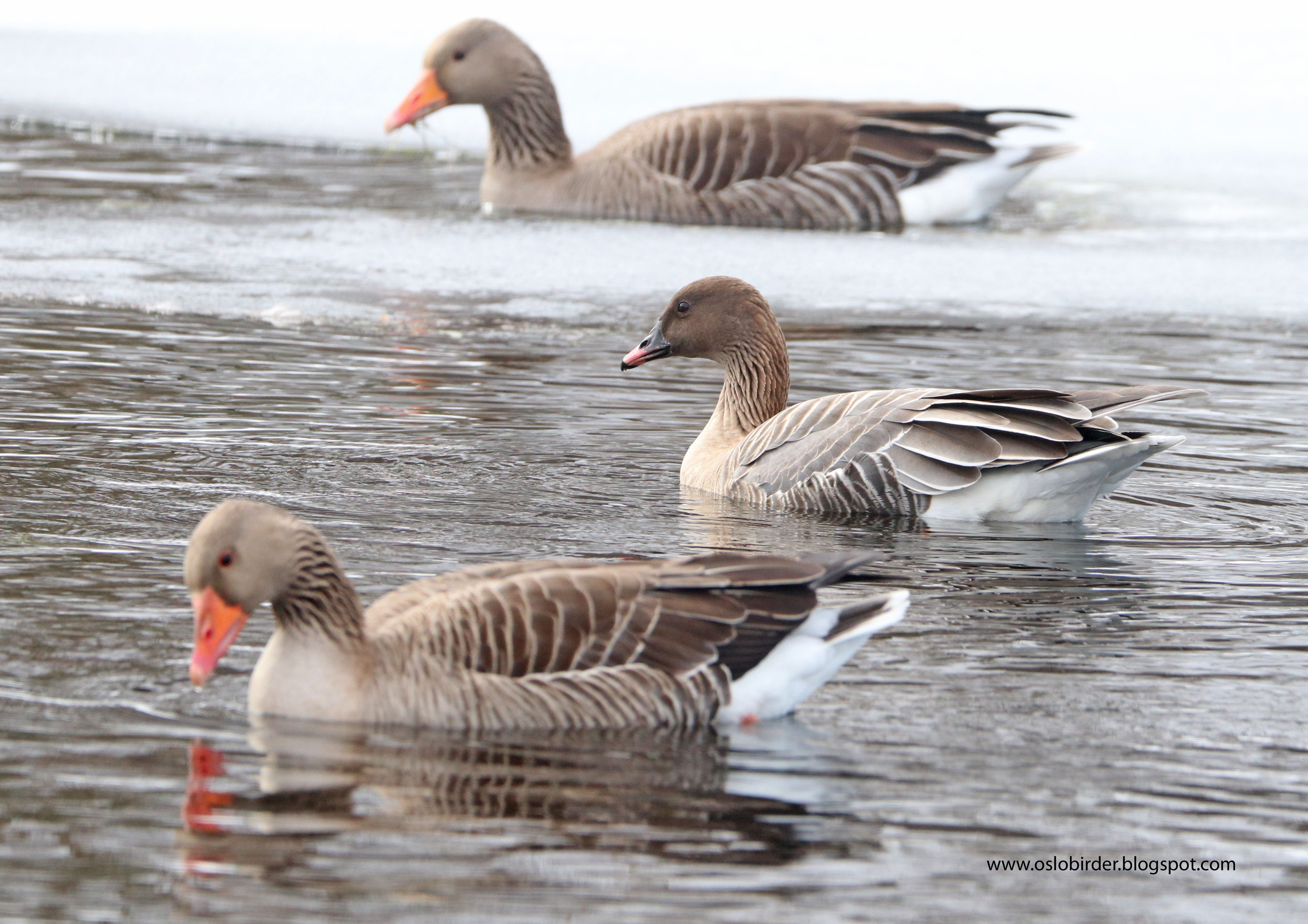
I have seen a number of flocks of Pink-footed Geese (kortnebbgås) migrating over Maridalen but this was the first bird on the lake. Together with a couple of Greylags (grågås)

female Sparrowhawk (spurvehauk)

Taiga Bean Geese (taiga sædgås) with a couple of Pink-feet

Twite (bergirisk) in Maridalen


White fronted Geese (tundragås) . 3 adults with extensive black belly barring and 2 young birds


my first Golden Plovers (heilo) of the year deserve a photo no matter how bad it is

male Marsh Harrier (sivhauk). He was calling although I never saw him together with the female

female

first Ring Ouzel (ringtrost)..

male Smew (lappfiskand) at Kallaksjøen


the Whtie-fronted Geese again